This loop starts and ends at Cookie Beacon Brunch Ferenciek Tere and opens seven doors in Budapest’s Belváros, the Inner City of District V. You pass a glass-roofed passage, a university library, the Paloma courtyard, a walled garden and three churches, one with an Ottoman prayer niche, and finish at a Roman fort site. Four of the seven are Budapest courtyards, gardens or passages, and you can step into them when their gates are open.
No stop is more than about 450 m in a straight line from Ferenciek tere 1, and the straight-line legs total about 1.9 km. Open the route in Google Maps for walking time; on a phone, Maps may drop some of the stops, so keep the table below to hand. Check the library’s closing days before you set out.
The game on this walk is doors: each stop is a threshold, such as a gate, an arch or a church door. Step through if it is open; if it is shut, read what is on it. Each stop has a short “Door status” line, checked against official pages where they exist.
Budapest courtyards and hidden gems: the seven doors at a glance
| # | Stop | Leg (straight-line) | Look for |
|---|---|---|---|
| 0 | Start: Ferenciek tere 1 | — | — |
| 1 | Párisi udvar, Ferenciek tere 10 | 50 m | The glass-prism roof of the passage |
| ↳ | The 1838 flood relief, Franciscan Church | 120 m | A dog on the roof |
| 2 | ELTE University Library, Ferenciek tere 6 | 80 m | White-on-black sgraffito on the front |
| 3 | Paloma courtyard, Kossuth Lajos utca 14–16 | 180 m | A staircase that splits into two arms |
| 4 | Károlyi kert (garden centre) | 260 m | Five gates into the garden |
| 5 | University Church, Egyetem tér | 180 m | Two hermit saints on the front |
| 6 | Serbian Orthodox Church of St George, Szerb utca 4 | 160 m | St George and the dragon in tiles |
| 7 | Inner City Parish Church, Március 15. tér | 480 m | The mihrab in the sanctuary wall |
| + | Contra Aquincum, Március 15. tér | 50 m | What is left of the Roman fort |
| ← | Back to Ferenciek tere 1 | 310 m | — |
Distances are straight lines between building centres, from OpenStreetMap coordinates.
Base camp: Ferenciek tere 1
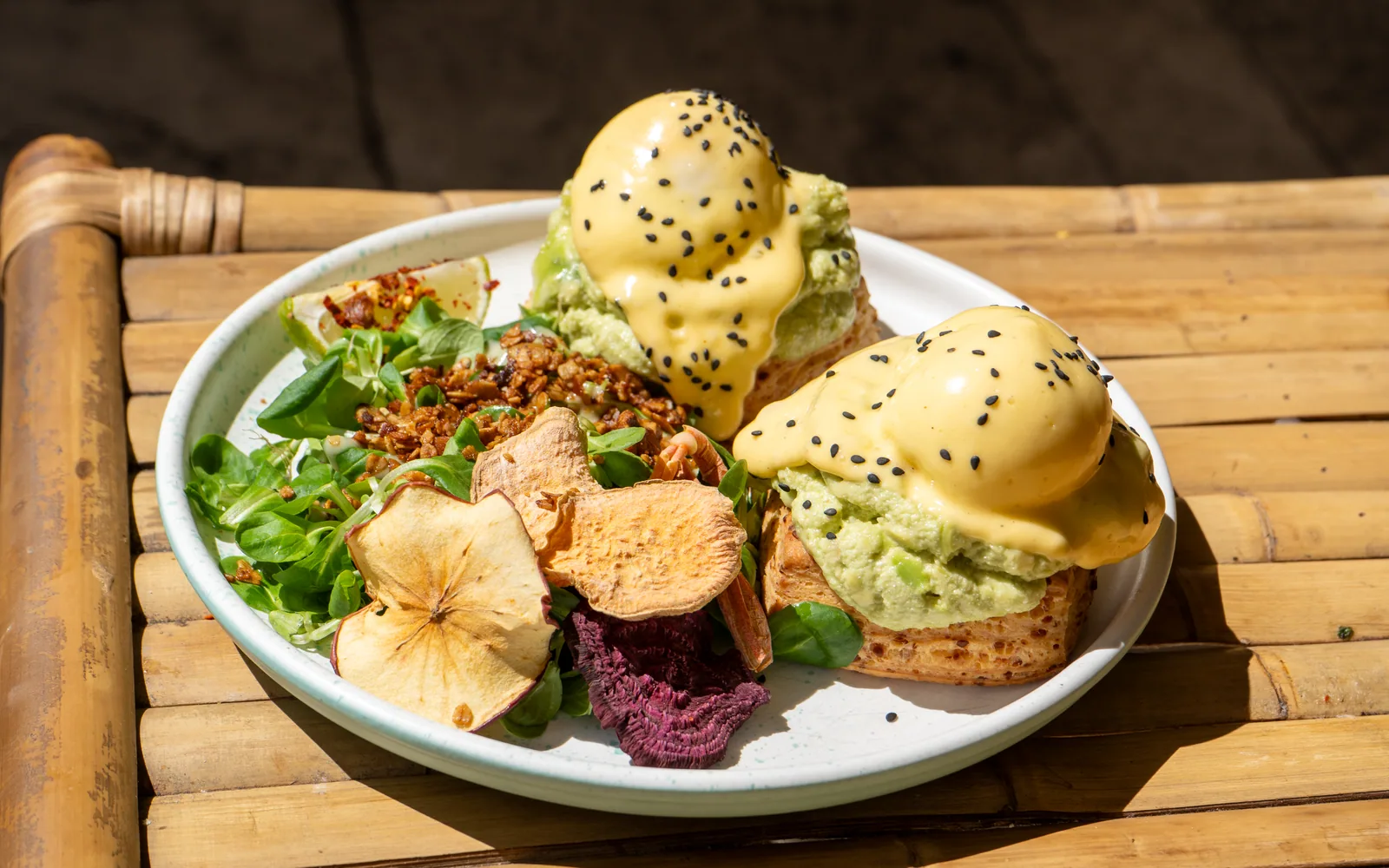
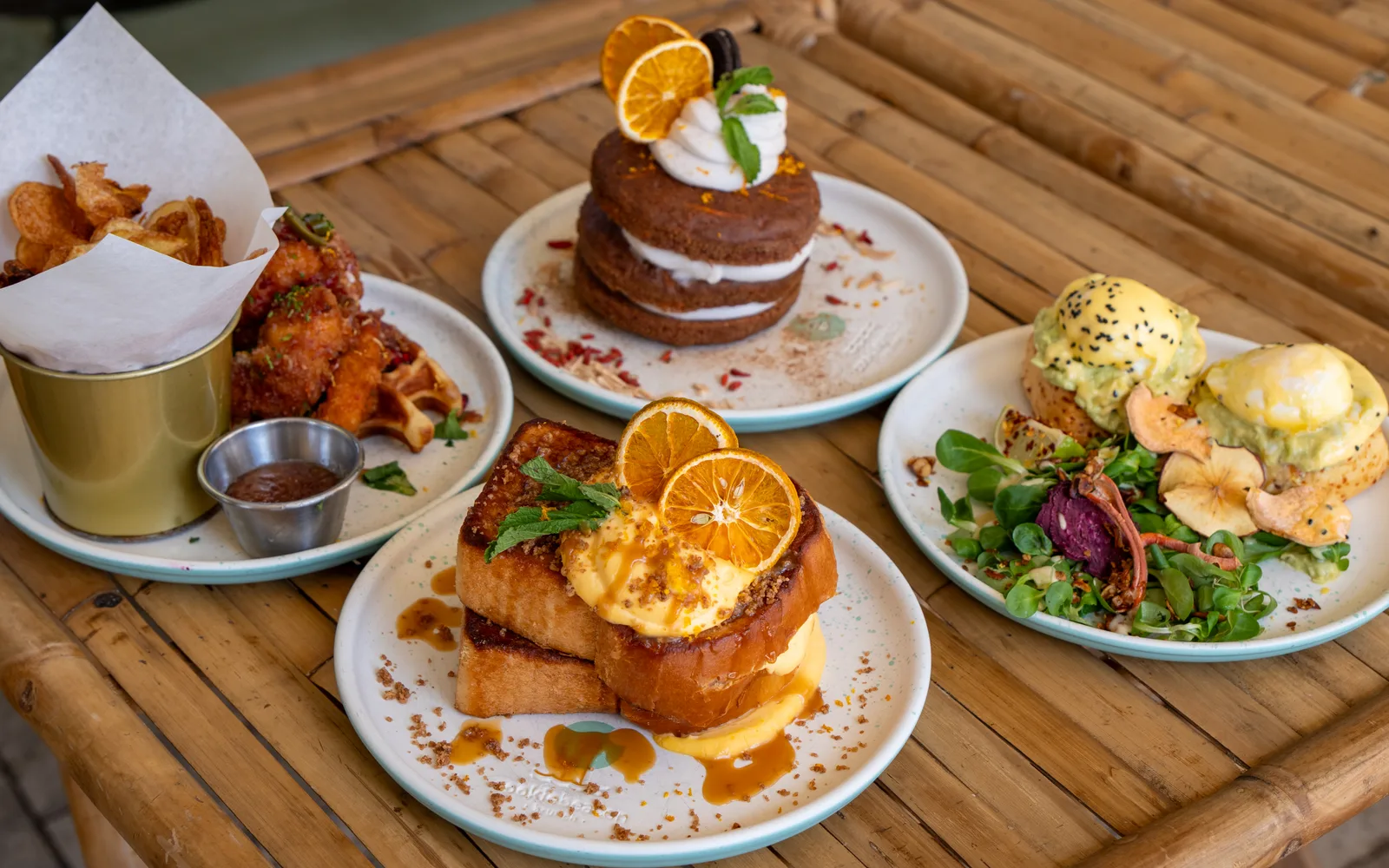
“Base camp” is a climbers’ word for the camp below a mountain, where every climb begins and ends. Here it is our brunch spot on the square. Eat before the first door. The Madrid Smashed Eggs (crispy potatoes and runny-yolk eggs) carry you through seven stops, and an Orange Espresso Tonic is the drink for it. The full Ferenciek tere menu has the prices for this spot.
Door 1: Párisi udvar, the glass-roofed passage
Udvar means “courtyard” in Hungarian, and this one is a covered passage. The Inner City Savings Bank built it in 1909–1913 as its headquarters, to a design by Henrik Schmahl. The name is older than the building: the 1817 house on this plot had a shopping arcade, and the story goes that it copied a passage in Paris.
Since 2019 the building has been a hotel. When it was about to open, the announcement said the passage would stay open to walk through (xpatloop, June 2019).

Look for: the roof of the passage. It is made of pressed-glass prisms, which took about a year and a half to fit, according to the building’s Hungarian Wikipedia article.
Door status: a hotel passage with no published public hours. If the doors are shut, the portal on the square is the stop.
On the way: the 1838 flood relief on the Franciscan Church
This one is not a door. Think of it as the doormat. On the outer wall of the Franciscan Church, on the corner with Kossuth Lajos utca, a bronze relief by Barnabás Holló shows the great flood of March 1838. Baron Miklós Wesselényi stands in a rowboat and holds out an oar to a family on a rooftop (We Love Budapest, 2018). Keep the flood in mind. It comes back twice on this walk.

Look for: the dog on the roof, next to the family. Then the two dates on the stone frame: 1838 for the flood, 1905 for the relief.
Door 2: ELTE University Library
Next door, at Ferenciek tere 6, is the library of ELTE (Eötvös Loránd University). The building was finished in 1876 to designs by Antal Skalnitzky and Henrik Koch Jr., and frescoes by Károly Lotz cover the walls and ceiling of the great reading hall (We Love Budapest, 2015). In 2025 a reader vote named it the city’s most beautiful university library (Eduline, 2025).
It is a working library, not a museum, so ask at the entrance whether a visitor may step into the hall.
Look for: the band of sgraffito below the upper row of windows on the front: white figures on a black ground, designed by Mór Than (We Love Budapest, 2015). Sgraffito is a decoration scratched through layers of coloured plaster. You can see it from the square, whether the doors are open or not.
Door status: Monday to Friday 09:00–20:00, Saturday 10:00–18:00, closed on Sundays, and closed on 23 and 24 October 2026 (ELTE University Library, checked on 21 October 2026).
Door 3: the Paloma courtyard in the Wagner house
Cross Kossuth Lajos utca to number 14–16. The front is plain, and that is on purpose. In the 1890s the city planned a new Danube bridge and a wider street here, so the architect János Wagner set his house back by 5–6 metres. He built it for his own family. They lived on the first floor and rented out the floors above (We Love Budapest, 2023).
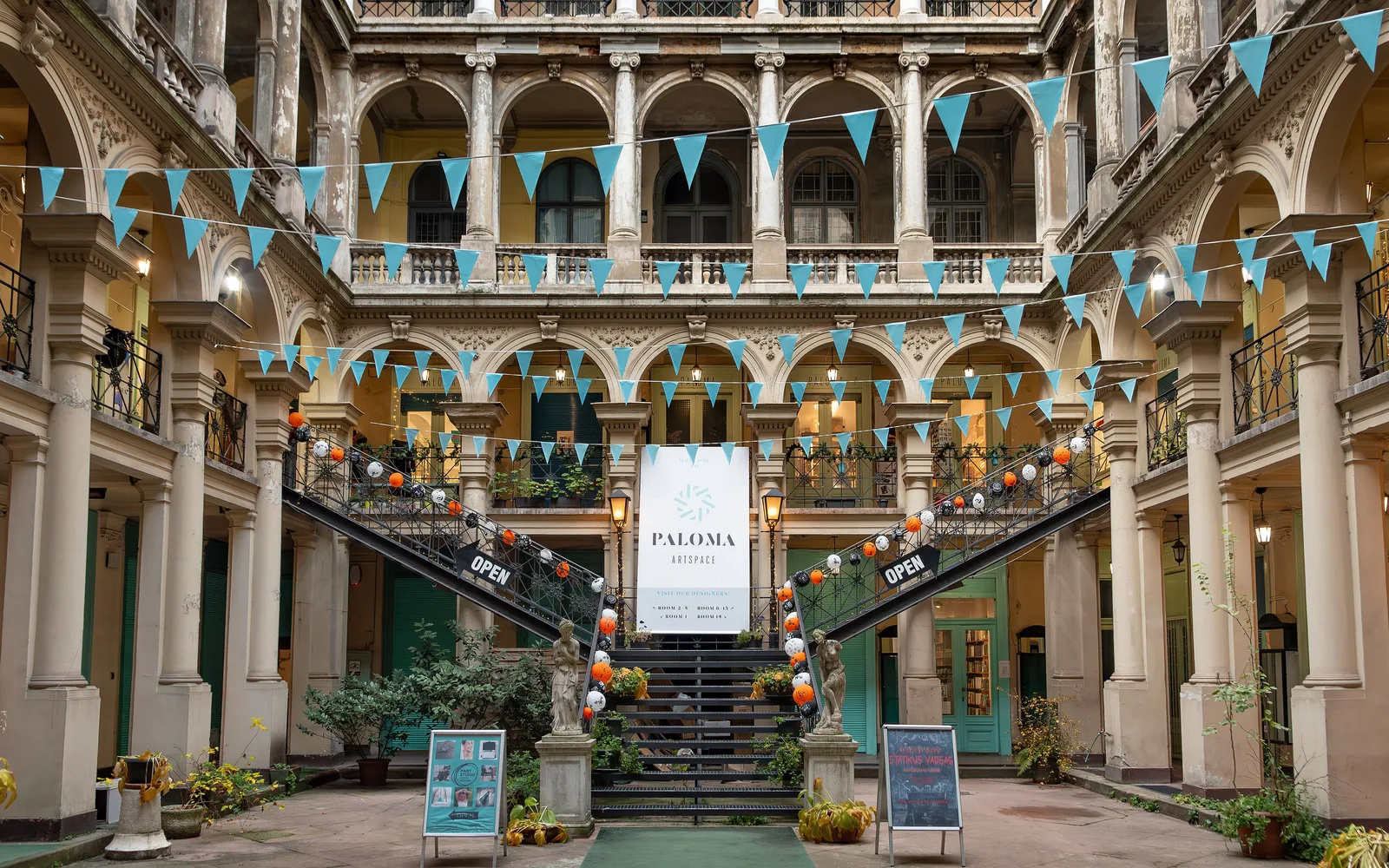
The courtyard behind the gate is the opposite of the front: stone balustrades, wrought-iron railings and arches on every level. The name Paloma comes from a department store that traded here in the 1990s. Since 2014 the ground floor and galleries have held shops and studios of Hungarian designers.
Look for: the iron staircase in the middle of the courtyard. It splits into two arms, with a stone statue at each side of its foot.
Door status: Paloma keeps shop hours, not museum hours, and no official page with its hours was found. Plan it for a weekday or Saturday daytime.
Door 4: Károlyi kert, the walled garden
Károlyi kert is the garden behind the Károlyi Palace. The Károlyi family owned it from 1768. Count Mihály Károlyi opened it to the public in April 1919. It closed again soon after, and the city bought it in 1928. It has been a public garden since 1932 (Pesti and Tarjányi, Parks and Gardens in Pest and Buda). The same guide singles out a heavily pruned white mulberry, probably the garden’s oldest tree and perhaps one of the oldest mulberries in Hungary, and counts four playgrounds.

Look for: the gates. The guide says five lead into the garden, set in a wrought-iron fence designed for the 1996 rebuild. The guide is older than today’s layout, so count them yourself as you walk around the fence.
Door status: the garden is gated. The guide gives its hours as 08:00 until 17:00, 18:00 or 21:00, depending on daylight; check the times on the gates on arrival.
Door 5: the University Church
The playful part of the walk pauses for the next three stops. They are working churches.
The University Church on Egyetem tér was built by the Pauline order, a Hungarian order of monks. The first Mass was held here in 1742. When the order was dissolved in 1786, the church passed to the university (We Love Budapest, 2020). Inside are ceiling frescoes by Johann Bergl and oak pews with carved panels. The architect was probably András Mayerhoffer.
Look for: the two saints between the towers and the gable. They are St Paul the Hermit and St Anthony the Hermit, and the Pauline coat of arms sits at the top. A 2018 list of the city’s flood markers includes a marble map at the corner of Egyetem tér and Király Pál utca (We Love Budapest, 2018).
Door status: there is no official visiting-hours page. Enter only outside services, and respect anyone at prayer.
Door 6: the Serbian Orthodox Church of St George
Around the corner on Szerb utca (“Serbian Street”), a yellow church stands in a garden behind a stone wall. It was built in 1733 to plans by András Mayerhoffer of Salzburg, likely the same master builder as the University Church, about 160 m away. In the early 18th century Serbs were a large part of Pest’s population. Today this is the only Serbian Orthodox church in Budapest (Wikipedia). If your trip goes on to Serbia, our Belgrade spot is Cookie Beacon Kralja Petra.
The flood comes back here. The water of 1838 damaged the church’s old iconostasis, the screen of icons in front of the altar. The present one dates from 1850.

Look for: the ceramic picture of St George slaying the dragon, on the corner of Szerb utca and Veres Pálné utca. If the gate is open, look at the inner side of the garden wall. Gravestones of Pest’s Serbian families are set into it.
Door status: an active parish with no published visiting hours. If the gate is shut, the wall, the tower and the corner picture are the stop.
Door 7: the Inner City Parish Church and its mihrab
Walk west along Szerb utca to Váci utca, then on toward the river and Március 15. tér. The Inner City Parish Church has Romanesque roots. St Gerard (Gellért), the bishop, was buried here in 1046. The church was rebuilt in Gothic style from the 14th century, and again in Baroque style after a fire in 1723 (Wikipedia).
Under Ottoman rule the church was used as a mosque. The church’s own website says the mihrab, the prayer niche, was made then and faced Mecca, and that the Ottomans later returned the building to Christian worship (Inner City Parish).
Look for: the mihrab in the south-eastern wall of the sanctuary, the part of the church around the main altar (Wikipedia).
Door status: visitors Monday to Saturday 09:00–16:30 (ticket desk closes 16:00), full ticket 3,500 Ft, covering the church, crypt and towers; on Sunday the church itself is free to enter, but the crypt and towers are closed. Visits pause during Mass (Mon–Sat 17:00; Sun 10:00, and 18:00 in English) (Inner City Parish, checked on 21 October 2026).
Bonus: Contra Aquincum, a Roman fort in the square
The church stands next to the walls of a Roman fort, Contra Aquincum (Wikipedia). The fort was part of the Roman frontier on the Danube. Its soldiers guarded the border and kept the ferry crossing running (We Love Budapest, 2020).
Look for: what is left of the fort. We Love Budapest (2020) says the watchtower remains are shown in a covered display room on the square, so check on arrival whether you can see them.
Side quest (an optional extra): the church towers
This extra goes up, not along: it adds stairs, not distance. The Baroque towers of the Inner City Parish Church have had viewpoints since 2020 (We Love Budapest, 2020). They are open Monday to Saturday 09:00–16:30, the ticket desk closes at 16:00, and they are closed on Sundays. Entry is on the same 3,500 Ft ticket as the church and crypt (Inner City Parish, checked on 21 October 2026).
The fork: rain, Sunday or kids
A fork is the point where you choose a path. Three choices matter here.
- If it rains: the Párisi udvar passage and the Paloma galleries give cover, and so do the churches when they are open. Skip the garden and the square.
- If it is Sunday: the library, the crypt and the towers are closed, and Paloma’s hours are unknown. Do doors 1, 4, 6 (from outside) and 7 between services, then the Roman fort.
- If you have kids: the guide counts four playgrounds in Károlyi kert, and St George’s dragon on the corner tiles is a good target. Give them the job of counting the gates into the garden.
Back to base
From Contra Aquincum it is about 310 m in a straight line back to Ferenciek tere 1. You have earned a cookie: the Cinnamon-Roll Cookie is baked in-house at our brunch spot, Cookie Beacon on Ferenciek tere, and you can sit down with it or take it to go.
Inner City Parish Church and ELTE Library opening hours: practical box
Checked on 21 October 2026.
| Stop | Hours (official source) | Notes |
|---|---|---|
| Párisi udvar | No published hours | Hotel since 2019; passage announced in 2019 as open to walk through |
| Franciscan Church relief | Outside wall, always visible | Corner of Kossuth Lajos utca |
| ELTE University Library | Mon–Fri 09:00–20:00, Sat 10:00–18:00 (the reading hall lists 10:00–20:00), Sun closed; closed 23–24 Oct 2026 (konyvtar.elte.hu) | Working library; reader’s card for self-service |
| Paloma courtyard | No official page found | Shop hours; go Mon–Sat daytime |
| Károlyi kert | 08:00 to 17:00, 18:00 or 21:00 by daylight, per the Pesti and Tarjányi guide; check the gates | Gated garden |
| University Church | No official page found | Working church |
| Serbian Orthodox Church | No published hours | Active parish; wall and corner tiles visible from the street |
| Inner City Parish Church | Mon–Sat 09:00–16:30, ticket desk to 16:00, 3,500 Ft for church, crypt and towers; Sun church free, crypt and towers closed (belvarosiplebania.hu) | Visits pause during Mass; Saturday hours can change for weddings |
| Contra Aquincum | No official hours found | Remains in a covered display on the square; check on arrival |
Ferenciek tere is a station on the M3 metro line (Wikipedia) for onward travel.
More walks and the first day
From the same square, the Citadella walk up Gellért Hill climbs the other side of the river. Across District V, the Lipótváros bee hunt around St. Stephen’s Basilica plays a different game with Art Nouveau details. New to Budapest? Our first day in Budapest plan covers the basics.
Hero photo credits: Jorge Franganillo, CC BY 2.0, via Wikimedia Commons