This loop starts at Cookie Beacon Ferenciek Tere in central Pest, crosses Elisabeth Bridge, climbs Gellért Hill by the stairs behind the St Gellért monument to the Citadella, Budapest’s hilltop fortress, and the Liberty Statue, and comes back down past the Rudas Baths and over Liberty Bridge. Straight-line, the legs come to about 3.3 km; the hill makes the real walk longer, so check walking time in Google Maps. The Citadella reopened on 5 April 2026 after more than a decade closed, and its park and bastion terraces are free. One trap: on Fridays the paid exhibition opens only at 12:00.
The game on this walk is a summit quest: a climb with a start, a top and a way back down. Base camp is the place you eat and set out from. Each checkpoint below has one thing to find. The top is about 140 m above the river, so wear shoes with grip.
Citadella Budapest walk at a glance
| # | Checkpoint | Leg (straight-line) | Look for |
|---|---|---|---|
| 0 | Base camp: Ferenciek tere 1 | — | — |
| 1 | Elisabeth Bridge | 554 m | Queen Elisabeth in her garden at the Buda end |
| 2 | St Gellért monument | 309 m | Game paused (religious monument) |
| 3 | The Citadella | 295 m | A V-shaped gap over the old main gate |
| 4 | The Liberty Statue | 135 m | Game paused (political memorial) |
| 5 | Rudas Baths | 259 m | The name over the riverside entrance |
| 6 | Liberty Bridge | 650 m | Bronze birds on top of the masts |
| 7 | Central Market Hall (waypoint) | 322 m | A patterned tile roof |
| 8 | Back to base camp | 800 m | — |
Every leg above is measured as the crow flies on OpenStreetMap; the hill paths and the stairs add distance, and checkpoint 2 to 3 is where they add the most. For walking time, use the Google Maps route. On a phone browser the link may drop some of the stops; if it does, follow the checkpoints below in order.
Base camp
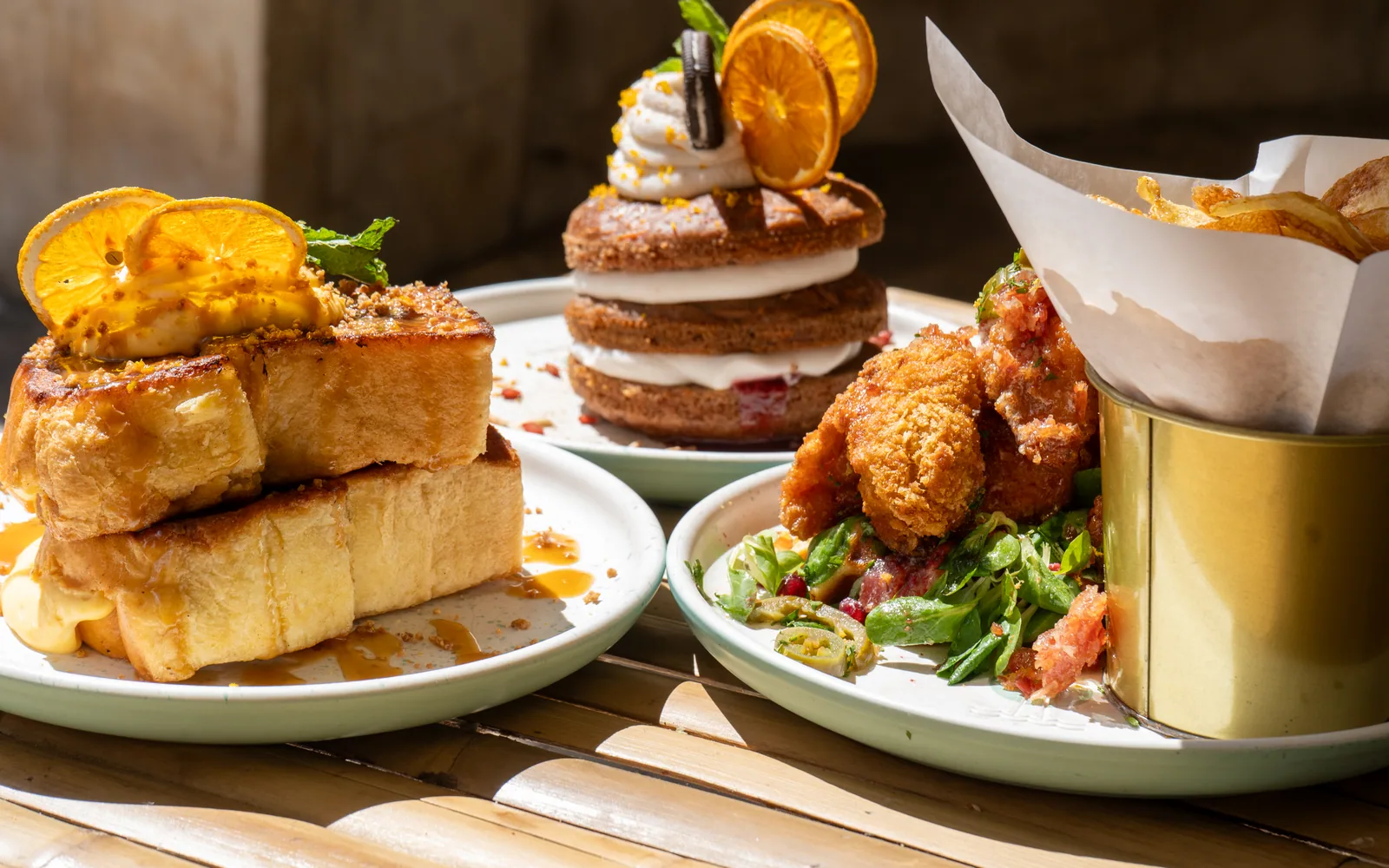
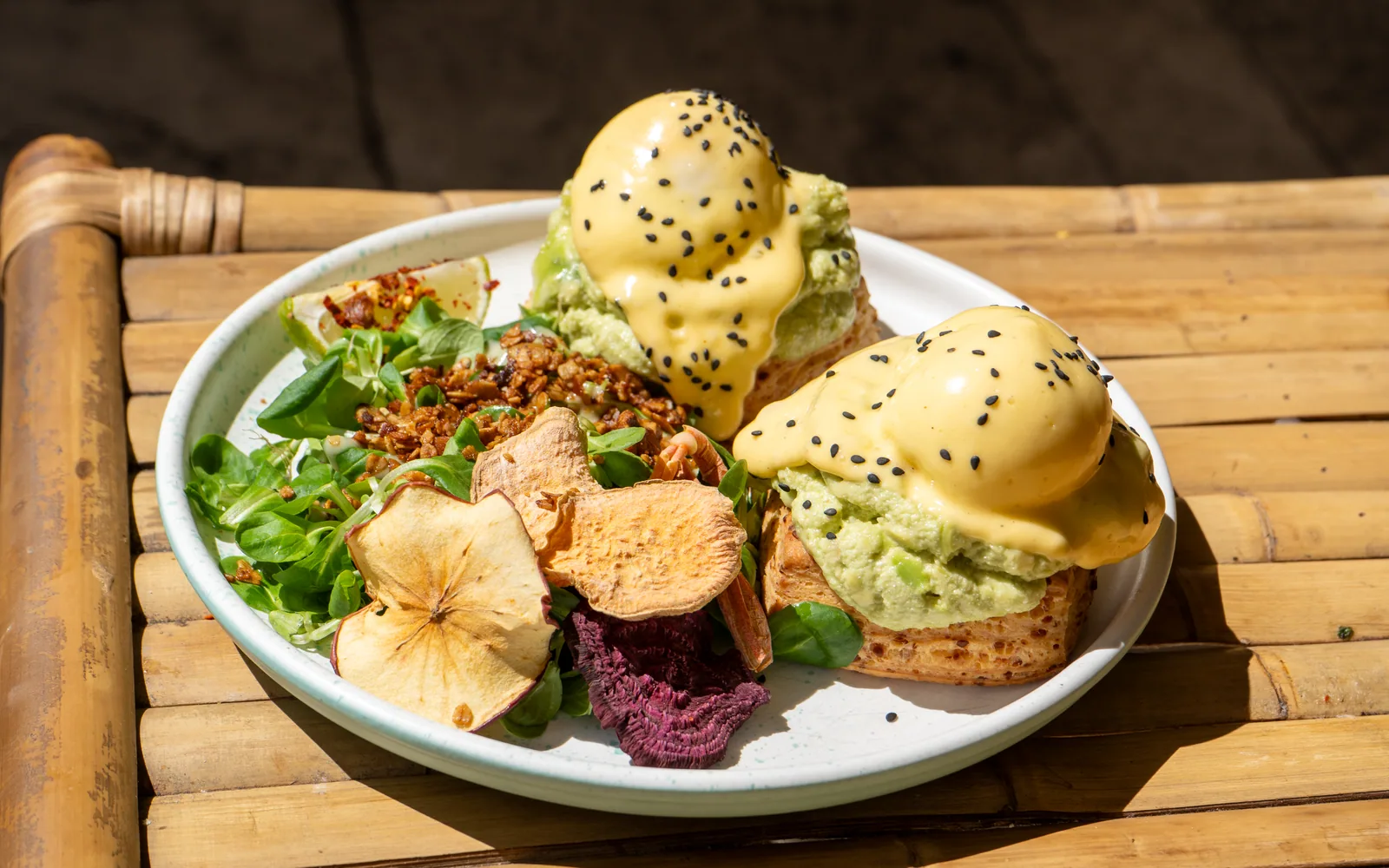
A hill climb is a good reason for a savoury plate. The Madrid Smashed Eggs put crispy potatoes under runny-yolk eggs; a flat white goes with them. Take a bottle of still water for the stairs. Everything else is on the Ferenciek tere menu.
1. Elisabeth Bridge

Photo: Fuhluf, CC BY-SA 4.0, via Wikimedia Commons
Walk west from base camp to the river. The bridge in front of you is the second one on this spot. The first, an ornate chain bridge, opened in 1903. At the end of the Second World War, retreating German troops blew it up, and it was the only Budapest bridge that could not be rebuilt in its original form. The plain white cable bridge you cross today, designed by Pál Sávoly, opened on 21 November 1964. It spans the Danube where the river is narrowest in Budapest, about 290 m.
The name comes from Queen Elisabeth, the Bavarian-born empress known as Sisi, who was assassinated in 1898.
Look for: at the Buda end, a large bronze of Queen Elisabeth in a small garden by the bridgehead. It stood at the Pest end of the old bridge until 1953 and was set up here, at the Buda end, in 1986.
2. The St Gellért monument

Photo: Yair-haklai, CC BY-SA 4.0, via Wikimedia Commons
This is a religious monument, so the game pauses here.
The hill takes its name from Gellért (Gerard), a missionary bishop. The Citadella’s own history page gives the medieval legend: in 1046, during a pagan uprising, rebels threw him from the rocky, river-facing side of this hill. The story goes that he was rolled down in a barrel. His bronze statue faces the bridge from a white colonnade, cross raised over the city, with an artificial waterfall below.
The stairs start here. OpenStreetMap names this path the Szent Gellért lépcső, the St Gellért steps. Count the steps yourself on the way up.
Notice: the figure at the bishop’s feet, below him.
3. The Citadella

Photo: Fred Romero (2017), CC BY 2.0, via Wikimedia Commons
You have reached the top. The Citadella is a Habsburg fortress, built from 1850 after the defeat of Hungary’s 1848–49 War of Independence; imperial troops moved into it in 1854. The official history gives its size as 220 m long and 60 m wide, with walls about 4 m thick. In February 1945 Soviet troops took it, and the walls still show the bullet marks.
Since the reopening, the inside of the walls is a public park of more than 6,000 m². Look out from the free terraces on the bastions: the north one faces Elisabeth Bridge and Margaret Island, the east one Liberty Bridge (official viewpoint page). The paid exhibition, A Szabadság Bástyája (The Bastion of Liberty), fills the western gun tower and leads to the Tetőkert 360 roof terrace.
Look for: the V-shaped gap above the main gate, the Nagykapu. In 1899, after the army left, people from Pest started to pull the fortress down. Full demolition never happened, for lack of money, and the gap stayed. Then find the bronze strip set in a round patch of paving in the park. The park page explains it: it marks a reference point for Hungarian land surveying, and the line between East and West Hungary.
4. The Liberty Statue
This is a political memorial, so the game pauses here too.
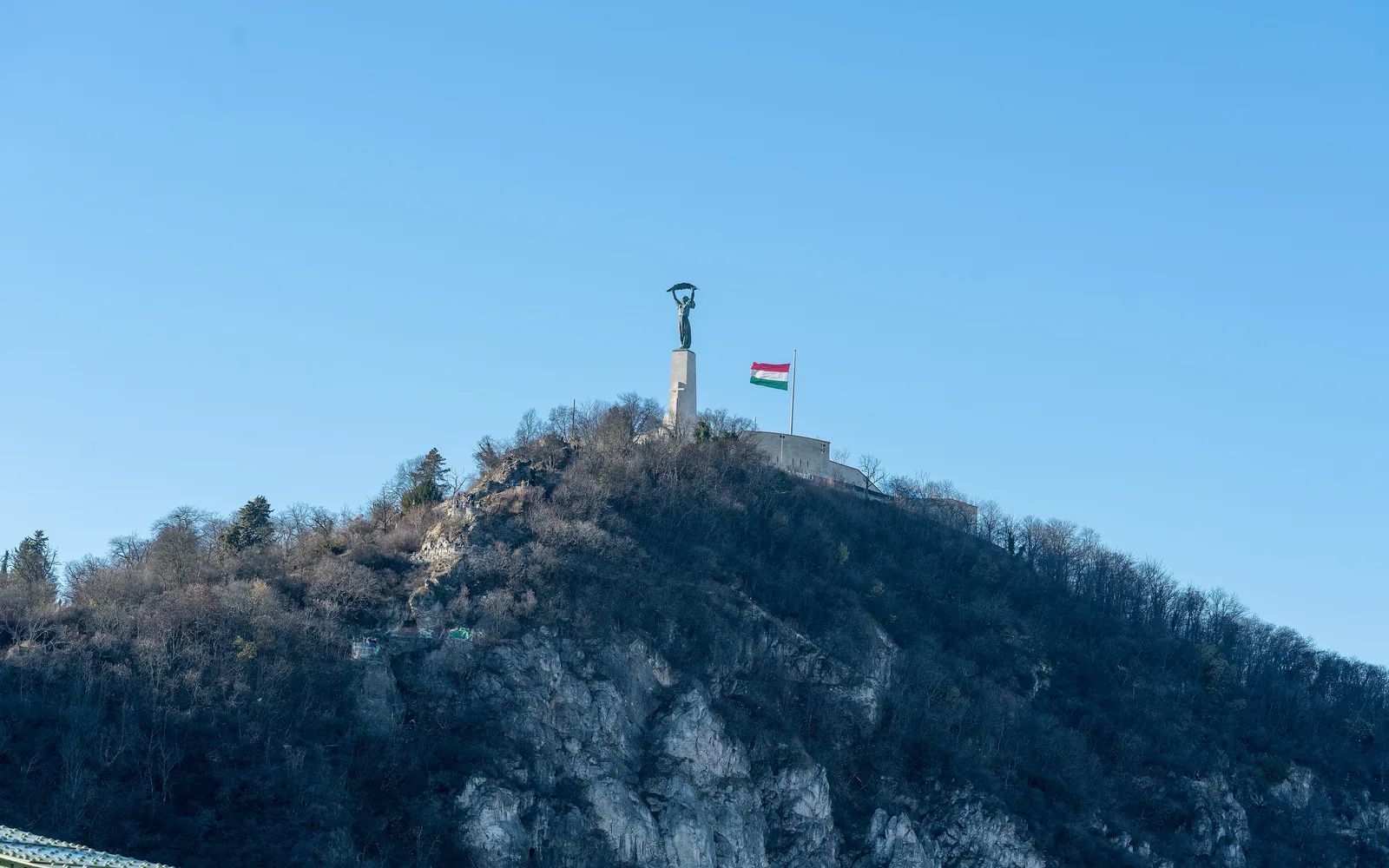
The Liberty Statue was put up on the summit in 1947, made by Zsigmond Kisfaludi Strobl. According to the official history, the whole monument is 40 m tall and the bronze figure alone is 14 m. It was first called the Liberation Monument, after the Soviet army’s victory in 1945. In 1956, during the revolution, people pulled down the statue of a Soviet soldier in front of it. After the end of communist rule, the parts that referred to the Soviet Union were removed. Today the official site describes the figure as a symbol of peace and freedom.
Notice: the palm leaf held over her head. It is the shape you could see from Elisabeth Bridge on the way up.
5. Rudas Baths
Go down the hill towards Elisabeth Bridge. At its Buda end stand the Rudas Baths, which date from the Ottoman period in the 16th century. Inside, an octagonal pool sits under the old domed hall. The official site, checked on 21 October 2026, lists the baths as open every day from 06:00. The Turkish bath is for women only on Tuesdays, and for men only on Wednesdays and on Monday, Thursday and Friday mornings until 10:45. Children under 14 are not admitted.
Look for: the name over the riverside entrance. Then turn south and follow the river.
Side quest: the Cave Church
On the riverside path towards Liberty Bridge, a church is set into the rock of the hill. Going in adds about 140 m in straight lines. It is a place of worship, so the game pauses inside; keep your voice low.
Pauline monks opened the Cave Church in 1926. In 1951 the communist state police arrested the monks and sealed the entrance with a concrete wall. It reopened in 1989. The official site, checked on 21 October 2026, gives Monday to Saturday 09:30–19:30; it is closed on Sundays, and visitors cannot go in during the 17:00 Mass, held every day.
Notice, from the path outside: the monastery’s neo-gothic turrets.
Further south you pass the Gellért Baths building at the end of Liberty Bridge. The official site says it has been closed since 1 October 2025. Do not plan on going in.
6. Liberty Bridge

Photo: Ranbar, CC BY-SA 3.0, via Wikimedia Commons
The green bridge home opened in 1896 as the Franz Joseph Bridge, in the year Hungary celebrated its thousand-year anniversary. János Feketeházy designed it. Wikipedia records that the emperor himself put in the last rivet, a silver one, on the Pest side. After the war it was the first of the city’s bridges to be rebuilt.
Look for: the four bronze turul birds on top of the masts. The turul is a falcon-like bird from Hungarian origin legends.
7. Central Market Hall
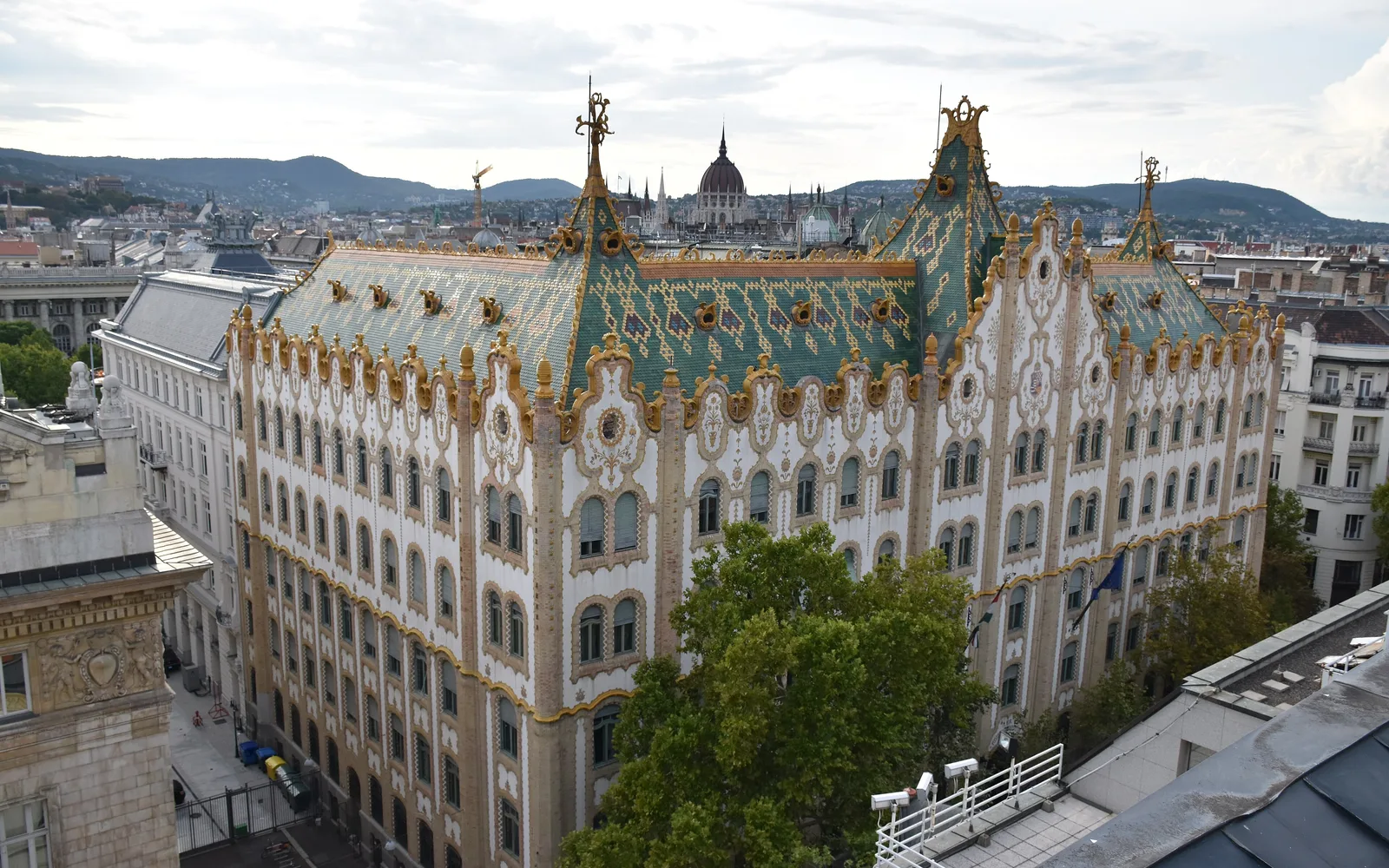
At the Pest end of the bridge stands the Central Market Hall. It is a waypoint, not a stop: note the patterned tile roof and keep going. Its upstairs food stalls are a lunch plan for another day.
The fork
- If it is Sunday: the Cave Church side quest is closed. Walk straight on along the river to Liberty Bridge.
- If it is winter, or you would rather not climb: steps on a hill can be icy, and it gets dark early. Instead of the stairs, take bus 27 from Móricz Zsigmond körtér (on metro line M4) to the Búsuló Juhász (Citadella) stop. The Citadella’s FAQ says the north entrance is about 500 m from the stop. Then walk down the hill on foot, or take bus 27 back down.
Return to base
From the Market Hall it is 800 m in a straight line back up Váci utca to our spot at Ferenciek tere 1. You climbed a hill; the Pecan Toffee Crunch cookie is the summit prize. We close at 17:00 every day.
Citadella opening hours and tickets (checked 21 October 2026)
Hours, prices and rules change, so follow the official links before you go.
| What | Details |
|---|---|
| Start and finish | Ferenciek tere 1, 1052 Budapest; hours on the store page |
| Route | About 3.3 km in straight lines; longer on foot, with a steep climb. Google Maps walking route |
| Citadella park | Free. Nov–Mar 08:00–22:00, Apr–Oct 06:00–24:00 (citadella.hu) |
| Exhibition A Szabadság Bástyája | Mon–Thu and Sat–Sun 10:00–18:00, Fri 12:00–20:00. Last entry 16:40, Fri 18:40 (citadella.hu, ticket page) |
| Exhibition tickets | Adult 4,900 Ft; ages 6–26 and pensioners aged 62–70, 2,450 Ft; under 6 and 70+, free with a registration ticket. Timed 20-minute entry windows; buy online or on site (official ticket page, online sales). Includes an audio guide (official FAQ) |
| Free at the top | Park, bastion terraces, wall walkway, Liberty Statue (official FAQ) |
| Step-free access | The stairs from the bridge are not step-free. The official FAQ says the park and exhibition are wheelchair-accessible, with a lift in the rondella; use bus 27 to the Búsuló Juhász (Citadella) stop. The FAQ does not say whether the path from the stop is step-free, so check with the Citadella before you go |
| Rudas Baths | Open daily from 06:00; closing time varies by day (official hours) |
| Cave Church | Mon–Sat 09:30–19:30, closed Sun; no visits during the daily 17:00 Mass (sziklatemplom.hu) |
| Gellért Baths | Closed since 1 October 2025 (gellertfurdo.hu) |
| Getting back | Ferenciek tere M3 metro station is at the start. Plan other legs in BKK’s BudapestGO |
More walks and plans
- Your first trip? Read your first day in Budapest before you set out.
- Also from Ferenciek tere, staying in Pest: seven courtyards and hidden doors behind Ferenciek tere.
- Across District V: the Bee Hunt, an Art Nouveau loop around St. Stephen’s Basilica.
Photo credits: hero image by Paul Colin Hennig (firstdorsal.eu), CC BY-SA 4.0, via Wikimedia Commons.