This self-guided walk leaves Cookie Beacon Amzei on Strada General Christian Tell, a few steps from Piața Romană, and follows Calea Victoriei south to Revolution Square, the square of the December 1989 revolution. Its nine stops, on a loop of about 2.2 km in straight-line legs, include a museum of donated art collections, a palace with four stone women on its top floor, a concert hall with a fresco once hidden under velvet, and the balcony of December 1989. Go on a Friday, Saturday or Sunday, the only days both art museums on the route are open.
Why walk Calea Victoriei from north to south
“Walked backwards” does not mean stepping backwards. It means going the opposite way to the usual tours. Most guided and audio walks of Calea Victoriei start in the south, near the Old Town, and walk north. This one starts near the northern end, where those tours finish, and walks south.
That direction also puts the avenue’s history roughly in order, like chapters in a book: the 1820s, the 1880s, 1939, 1948 and, last, 1989.
Route at a glance
| # | Stop | Leg (straight line) | Look for |
|---|---|---|---|
| 0 | Strada General Christian Tell 1-3 | start | — |
| 1 | Museum of Art Collections (Romanit Palace), Calea Victoriei 111 | 228 m | Two wings and a courtyard behind the fence |
| 2 | Știrbei Palace, Calea Victoriei 107 | 105 m | Four caryatids on the top floor |
| 3 | Biserica Albă (the White Church), Calea Victoriei 110 | 305 m | A white church set back from the avenue |
| 4 | Romanian Athenaeum | 214 m | The dome, and the poet’s statue in the garden |
| 5 | Central University Library | 174 m | The statue of King Carol I on horseback in front |
| 6 | Former Royal Palace (National Museum of Art) | 147 m | The long facade facing the square |
| 7 | Memorial of Rebirth | 147 m | A tall white pillar |
| 8 | Former Central Committee building | 108 m | The balcony over the square |
| 9 | Union of Romanian Architects, Str. Demetru I. Dobrescu 5 | 99 m | Old walls with glass behind them |
| ← | Back to Strada Christian Tell | 631 m | — |
The metres are measured on the map, in a straight line between OpenStreetMap points. Real streets make every leg a little longer, and nobody has timed this route on foot yet. Open the route in Google Maps for walking time. Allow extra time if you go into one of the museums.
Base camp
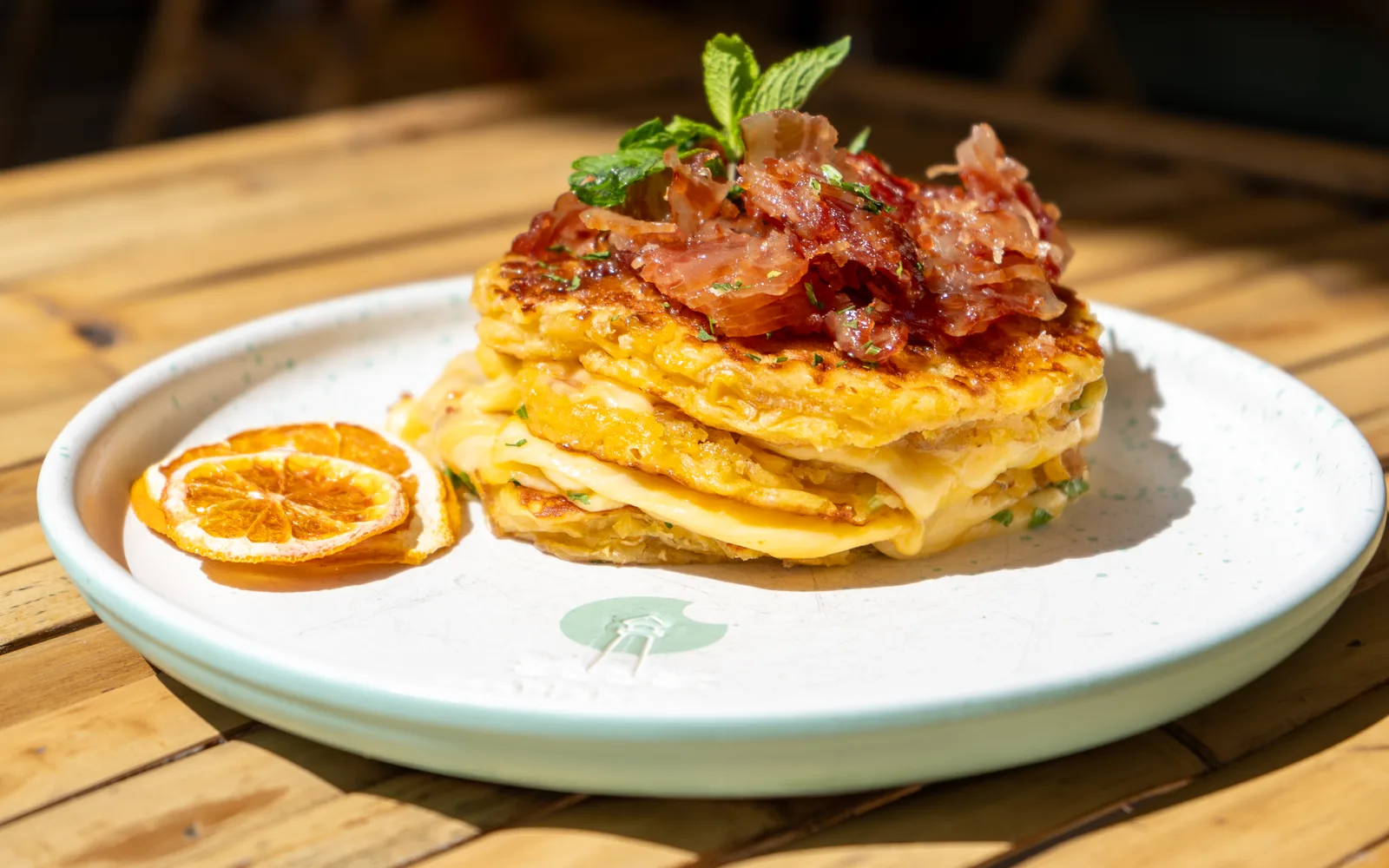
Climbers call the camp they leave from and return to “base camp”. On this walk it is your table on Strada Christian Tell. Before a walk with two museums in it, order something that lasts until lunch: the Eggs Benedict on Cheddar-Scones (that page is in Romanian) or the Croque Madame Pancake Stack, with a Maple Chai Latte or a flat white. You can read the Amzei menu before you go, in English or Romanian.
Then walk west to Calea Victoriei.
Museum of Art Collections: chapter one, the 1820s
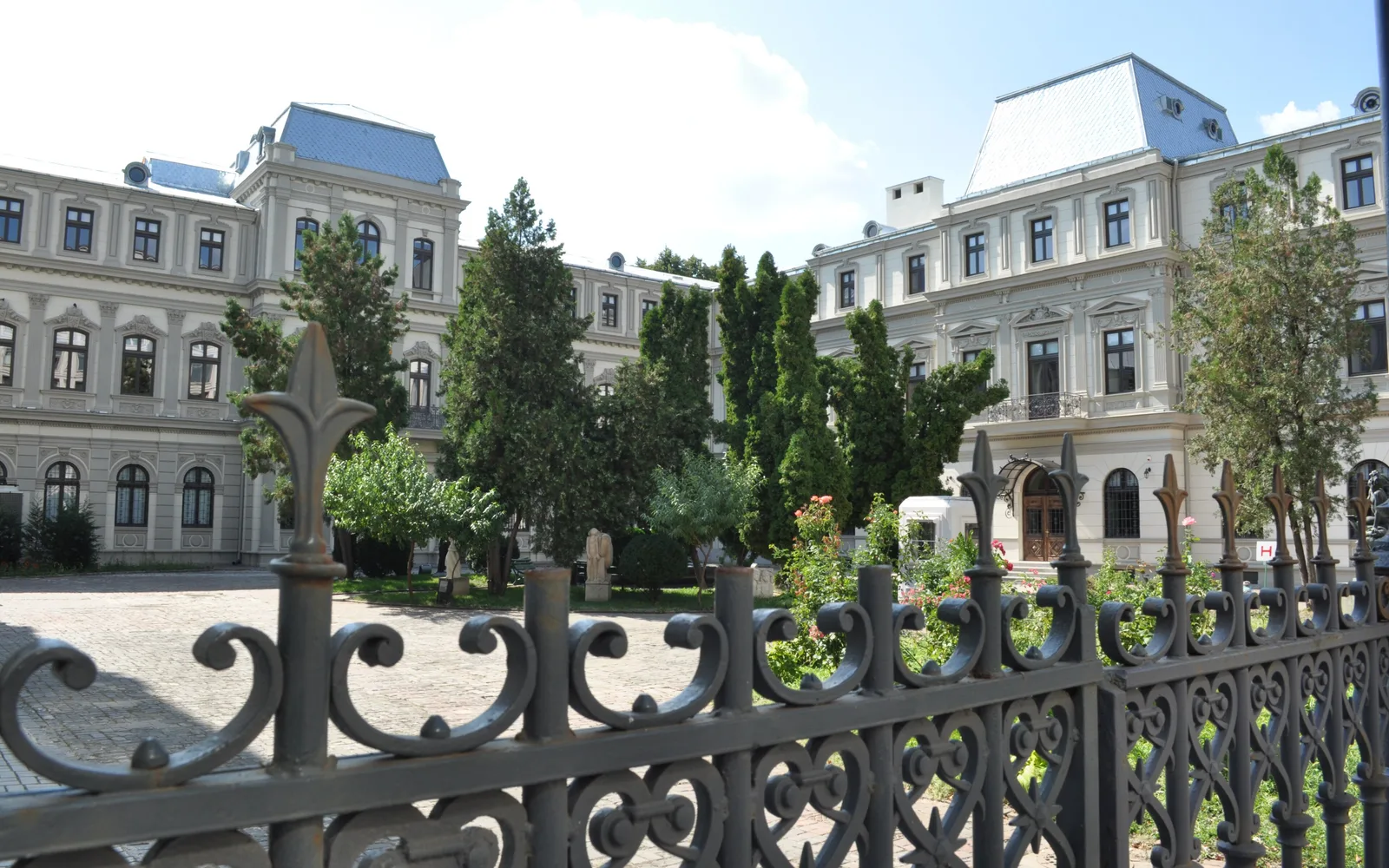
The Romanit Palace is the oldest palace on this walk. According to Wikipedia, the first part was built in 1822 for a boyar (a Romanian noble) named Faca, who died before it was finished. A Greek named Romanit bought it and gave it his name. Later the state bought it, and in the second half of the 1800s the Ministry of Finance moved in and added two wings. That is why the building has a U shape.
Today it is a branch of the National Museum of Art of Romania, with 44 collections that families gave to the state, starting in 1927. Each keeps its donor family’s name. One piece is a drawing by Vincent van Gogh.
Look for: the two wings reaching towards the street, and the carved stones standing in the courtyard.
Next stop: 105 m in a straight line, a few doors south.
Știrbei Palace: chapter two, the 1880s caryatids

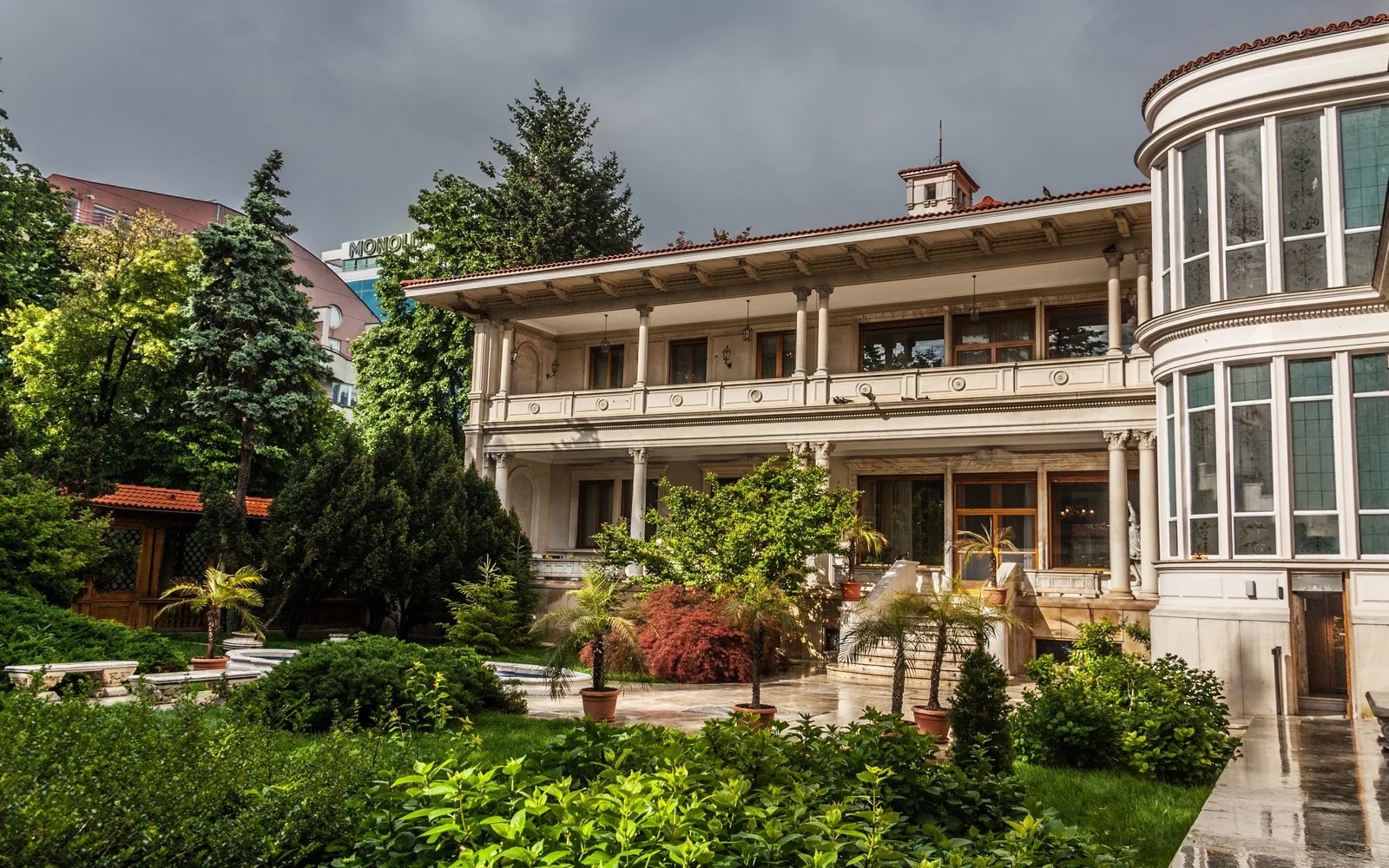
Barbu Știrbei, who later ruled Wallachia, built this palace around 1835. According to Romanian Wikipedia, the French architect was Michel Sanjouand. In 1881 the architect Friedrich Hartmann added a storey, a tower and four caryatids. A caryatid is a statue of a woman that does the work of a column.
The photo above is from 2011, before the restoration. In December 2025 the palace was launched as TOFF Galleries, a luxury department store (Romanian Wikipedia; Revista Biz).
Look for: the four caryatids along the top. Count them yourself, then compare the facade with the 2011 photo.
Next stop: 305 m in a straight line, on the other side of the avenue.
Biserica Albă: a short pause
Biserica Albă means “the White Church”. It is an Orthodox church, so keep your camera down during a service. According to Romanian Wikipedia, the church dates from the 18th century, and digs in 2012 found the altar of an even older church under today’s entrance hall.
Look for: the white walls set back from the traffic of the avenue.
Next stop: 214 m in a straight line to the Athenaeum.
Romanian Athenaeum: chapters three and four, 1939 and 1948
Our first day in Bucharest guide already sends you here, so this is the short version. The Athenaeum opened in 1888. Part of the money came from the public, under the slogan “Dați un leu pentru Ateneu!” (“Give a leu for the Athenaeum!”; the leu is Romania’s currency).
Inside, a painted band by Costin Petrescu runs around the concert hall: 25 scenes of Romanian history, about 70 metres long by Gândul’s count. It was unveiled on 26 May 1939, six years after work began. In February 1948, for the congress of the communist party, it was covered with red velvet to hide the role of the monarchy. The velvet came off only in the renovation of 1966–1967, according to Gândul.
Look for: the dome, and the statue of the poet Mihai Eminescu in the garden in front.
Next stop: 174 m in a straight line, across the square.
Revolution Square: December 1989
Here the chapters stop being a game. The next four stops stand around Piața Revoluției (Revolution Square). People died here in December 1989. Walk them slowly.
Central University Library
The library was designed by the French architect Paul Gottereau and opened in 1895. In December 1989 it burned. According to Wikipedia, more than 500,000 books and 3,700 manuscripts were lost. Repairs began in April 1990, and the library reopened on 20 November 2001.
Look for: the statue of King Carol I on horseback in front of the building (Romanian Wikipedia).
Next stop: 147 m in a straight line.
Former Royal Palace (National Museum of Art)
The palace you see was built in 1936–1937 by the architect Nicolae Nenciulescu, on the site of an older mansion. Since 1950 it has housed the National Museum of Art of Romania. In December 1989 it was seriously damaged and partly burned (Wikipedia).
Look for: the long facade along the west side of the square. Remember the closing days: this museum is closed on Monday and Tuesday.
Next stop: 147 m in a straight line.
Memorial of Rebirth
This memorial honours the struggles and the victims of the 1989 revolution. It was unveiled in August 2005 and is about 25 metres tall, in marble and metal. The designer was Alexandru Ghilduș (Wikipedia).
Look for: the metal crown at the top of the pillar.
Next stop: 108 m in a straight line.
Former Central Committee building
This was the headquarters of the Romanian Communist Party’s Central Committee. On 21 December 1989, Nicolae Ceaușescu spoke to a rally in the square from its balcony. The rally turned into a revolt. The next day, 22 December, he and his wife left the building by helicopter. Since 2006 the building has housed the Ministry of Internal Affairs (Wikipedia: Revolution Square; Wikipedia: Romanian revolution).
Look for: the balcony facing the square.
Next stop: 99 m in a straight line, into Strada Demetru I. Dobrescu.
Union of Romanian Architects: glass inside the old walls
The last stop is Casa Peucescu, a 19th-century house hit by artillery during the fighting of December 1989. About a decade later, the Union of Romanian Architects rebuilt it as its headquarters. The architects kept the old walls and put a modern glass building inside them (Adevărul). So one facade shows two centuries: an old shell, with new glass looking out through its windows.
Look for: places where the old walls cover part of the new windows.
From here the route turns north and heads back.
Side quests
Side quests are short extra stops, a term borrowed from video games. Skip them, or pick one if your legs still have energy.
Casa Mița Biciclista (69 m from the start)

This house stands on the corner of Strada Biserica Amzei and Strada Christian Tell, the same street as your base. It was built in the early 1900s with an Art Nouveau facade. Its owner was Maria Mihăescu, whom the writer George Ranetti nicknamed Mița Biciclista, “Mița the Cyclist”, around 1898. The story goes that she was one of the first women in Bucharest to ride a bicycle. Newsweek România describes the facade as covered in reliefs of cherubs, lions and cupids.
Look for: the lions and the cupids. Count them yourself. Sources describe them, but nobody gives a number.
Grădina Icoanei (about 770 m from the start)
This garden is south-east of Piața Romană. Before the 1830s there was a pond here, the Icoana Pond. It was drained, and the garden was laid out and finished in 1873 (Wikipedia). At the northern entrance stands a statue of the politician George Cantacuzino-Râfoveanu by the French sculptor Ernest Henri Dubois, unveiled in 1904. It is 610 m in a straight line from the architects’ building, so it also works on the way home.
Look for: the statue at the northern entrance, and try to picture water where the paths are.
The north spur: Cantacuzino Palace (about 685 m from the start)

This one goes north, the other way. The Cantacuzino Palace at Calea Victoriei 141 was built in the early 1900s for Gheorghe Grigore Cantacuzino, a former prime minister, to plans by the architect Ion D. Berindey. In 1939 the composer George Enescu married Maria, the widow of Cantacuzino’s son. The palace became the George Enescu National Museum in 1956 (Wikipedia).
Look, but don’t plan to go in. The museum’s official site lists the palace as closed for restoration and structural repairs, with no reopening date (checked on 21 October 2026).
Look for: the two stone lions on the steps and the iron-and-glass canopy over the door.
The fork
Like a fork in a road, the walk splits here into versions. Which one you take depends on the day of the week and on the weather:
- Monday or Tuesday: the National Museum of Art is closed. Spend your museum time in the Museum of Art Collections at stop 1.
- Wednesday or Thursday: the Museum of Art Collections is closed. Walk past it and save your museum time for the former Royal Palace.
- Friday to Sunday: both are open. On Saturday and Sunday they open at 11:00, so go out a little later, or do the square first and stop 1 on the way back.
- Rain: the two museums are your shelter. We could not confirm regular visiting hours for the inside of the Athenaeum, so don’t count on getting in.
Return to base
From the architects’ building, head back north towards Piața Romană. Finish with a chunky cookie: the Nutella & Maldon Salt is a good reward for 2.2 km of history. The Cookie Beacon on Strada Christian Tell page has the address, the opening hours and directions.
Calea Victoriei museum opening hours and free days
Museum hours are from mnar.ro as last published in a readable copy (May 2026; the live site blocked our check on 21 October 2026). The Enescu status was checked on georgeenescu.ro on 21 October 2026. Holiday closures change, so open the official links before you go.
| Details | |
|---|---|
| Start and finish | Strada General Christian Tell 1-3, Sector 1, near Piața Romană |
| Museum of Art Collections | Mon, Tue and Fri 10:00–18:00, Sat–Sun 11:00–19:00, closed Wed–Thu. Free entry on the first Tuesday of the month according to mnar.ro (some ticket listings say the first Friday, so check before you go). mnar.ro |
| National Museum of Art (former Royal Palace) | Wed–Fri 10:00–18:00, Sat–Sun 11:00–19:00, closed Mon–Tue. Free entry on the first Wednesday of the month. mnar.ro |
| Both museums in one walk | Friday to Sunday only |
| Booking | Not needed for visits without a guide; guided visits are booked by email at least 7 days ahead (mnar.ro) |
| George Enescu Museum (Cantacuzino Palace) | Closed for restoration and structural repairs, no reopening date. Exterior only. georgeenescu.ro |
| Romanian Athenaeum visits | No regular visiting timetable confirmed. Check the George Enescu Philharmonic before you go |
| Getting back | The last stop is 631 m in a straight line from the start, so walking back is easiest. Piața Romană metro station (line M2) is about 300 m in a straight line from the start; check routes on metrorex.ro |
Before you go
For a walk on the other side of Sector 1, try the long way to the Spring Palace, which starts in Floreasca. Reading Romanian? Parcul Floreasca și jocul străzilor (Floreasca Park and the street game) starts from the same neighbourhood.
Photo credits: hero image by Razvan85, CC BY-SA 3.0 ro, cropped and resized, via Wikimedia Commons.