
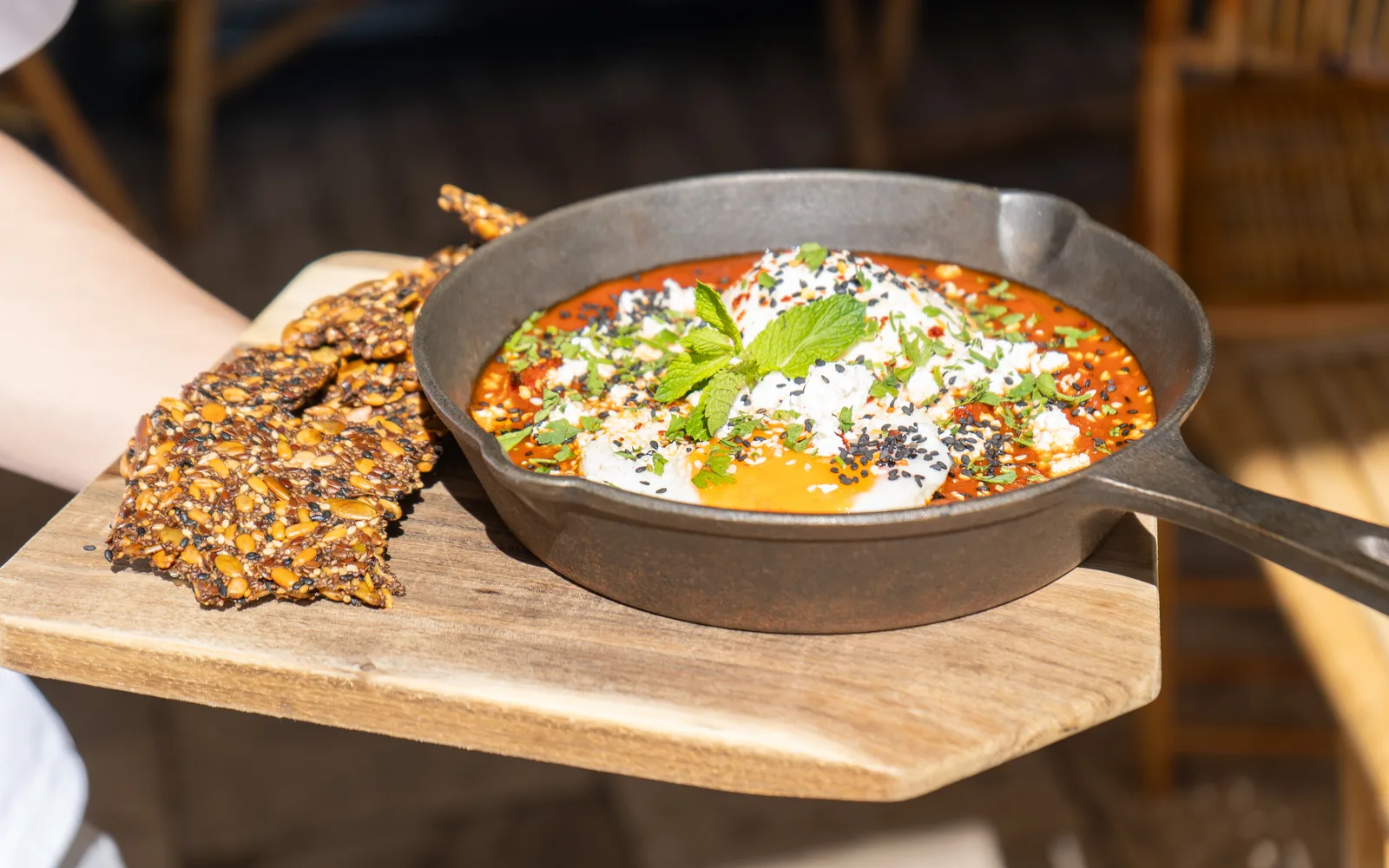
Our Shakshuka Burrata is a skillet of spiced tomato and pepper sauce with a sunny side up egg, burrata, feta crumble, parsley, sesame and chili flakes, served with homemade seed crackers, for 5,100 Ft at both Cookie Beacon brunch spots in Budapest.
It is the only plate on our menu for brunch in Budapest that the card offers to make vegan on request. Both spots serve it all day, and neither takes bookings.
Why put burrata in a shakshuka?
Here is the reason, from the people who put it on the card:
Cozy, piping hot Shakshuka is a brunch staple. A fried egg adds protein. A creamy burrata adds texture and comfort to the dish when it melts into the spicy tomato and pepper sauce.
The story has three parts, and each one is on the plate.
The staple. The base is the dish as people know it: a spiced tomato and pepper sauce, served hot. In our photos it arrives in a small cast-iron skillet on a wooden board.
The egg. The story says fried, and the card says sunny side up: one egg with a soft, bright yolk. Our menu tags the dish protein-packed at both Budapest spots.
The burrata. This is the part that gives the dish its name. In our photos it sits in the sauce as a white dome next to the egg, dusted with chili flakes and sesame. The story says what happens next: it melts into the spicy sauce and adds texture and comfort.
What is in the Shakshuka Burrata?
The burrata is in the name. The rest is what our Budapest menu lists, here with the Hungarian names:
- Spiced tomato and pepper sauce (fűszeres paradicsom-paprika szósz).
- Sunny side up egg (tükörtojás). The Hungarian word means mirror egg.
- Feta crumble (feta sajt, simply feta cheese on the Hungarian half). In our photos it is the small white crumbs scattered over the sauce.
- Parsley (petrezselyem).
- Sesame (szezámmag). Black and white seeds in our photos.
- Chili flakes (chili pehely).
- Homemade seed crackers (házi magos pirítós). The Hungarian half of the card literally says homemade seeded toast. What arrives in our photos is crackers: thin, dark and studded with whole seeds, stacked beside the skillet. They are included in the price.
That makes two cheeses in one skillet: burrata for the creamy middle, and feta for the salt.
What is burrata?
Burrata is a fresh Italian cheese from Puglia, in the heel of Italy. The outside is a pouch of mozzarella. The inside is stracciatella, soft shreds of mozzarella mixed with cream. Cut it open and the middle runs.
That is why it suits a hot dish. In our photos it arrives as an intact dome, and the story says what happens next: it melts into the spicy tomato and pepper sauce.
How is ours different from a classic shakshuka?
- The egg is fried, not poached. In the usual version the eggs are cracked into the sauce and cooked there. Our card gives it a sunny side up egg.
- There is burrata. The classic dish has no cheese at its centre. Ours has burrata melting into the sauce, plus feta crumble on top.
- Seed crackers instead of bread. Shakshuka is usually served with bread for scooping. Ours comes with homemade seed crackers.
How do you eat it?
Break the yolk first and let it run into the sauce. Then cut into the burrata so the creamy centre does the same.
Use the seed crackers as your spoon: scoop sauce, egg and cheese together. The story calls it piping hot, so mind the skillet.
Can you order it vegan?
Yes. Our card says: make it vegan, swap for tofu crumble (kérd vegán változatban, tofu morzsával). Ask for the vegan version when you order. The card does not print what else changes on the plate, so check with our team if that matters to you.
As it comes, the dish is vegetarian, and our menu tags it that way at both Budapest spots. It carries two more tags, protein-packed and spicy. It has no gluten-free tag, and everything is made in a shared kitchen, so if you avoid gluten, please check with our team when you order.
Where does shakshuka come from?
Shakshuka comes from North Africa. Most food writers place its origin in the Maghreb, and Tunisia is the country named most often, though the details are disputed. The name is usually explained as an Arabic word for a mixture.
From there it spread across the Middle East. North African Jewish families brought it to Israel, where it became an everyday breakfast, and in recent years it has become a regular on brunch menus around the world.
Where does it sit among our dishes?
Three plates on our Budapest menu are its closest relatives:
- Madrid Smashed Eggs, 4,500 Ft. Another egg plate with chili flakes that our menu tags vegetarian: runny yolk eggs over crispy potatoes, from Spain where this one is from North Africa.
- Eggs Benedict on Cheddar-Scones, 4,600 Ft. Also tagged vegetarian, with the same feta crumble, but built on poached eggs and hollandaise.
- Carrot-Cake Pancakes, 4,400 Ft. The other Hearty Brunch plate where our card uses the word vegan: it lists vegan fluffy pancakes, and tags the plate vegetarian. The shakshuka is the one the card offers to make vegan on request.
What should you know before ordering it in Budapest?
It sits in Hearty Brunch, the first section of our Budapest menu. The name stays in English on both halves of the card, so look for Shakshuka Burrata.
The price is the same at Basilica on Hercegprímás utca, near St. Stephen’s Basilica, and at Ferenciek tere, at the Váci utca end of the square. Both open 08:00 to 17:00 on weekdays and 09:00 to 17:00 at weekends, and both are walk-in only. The walk between them takes about fifteen minutes.