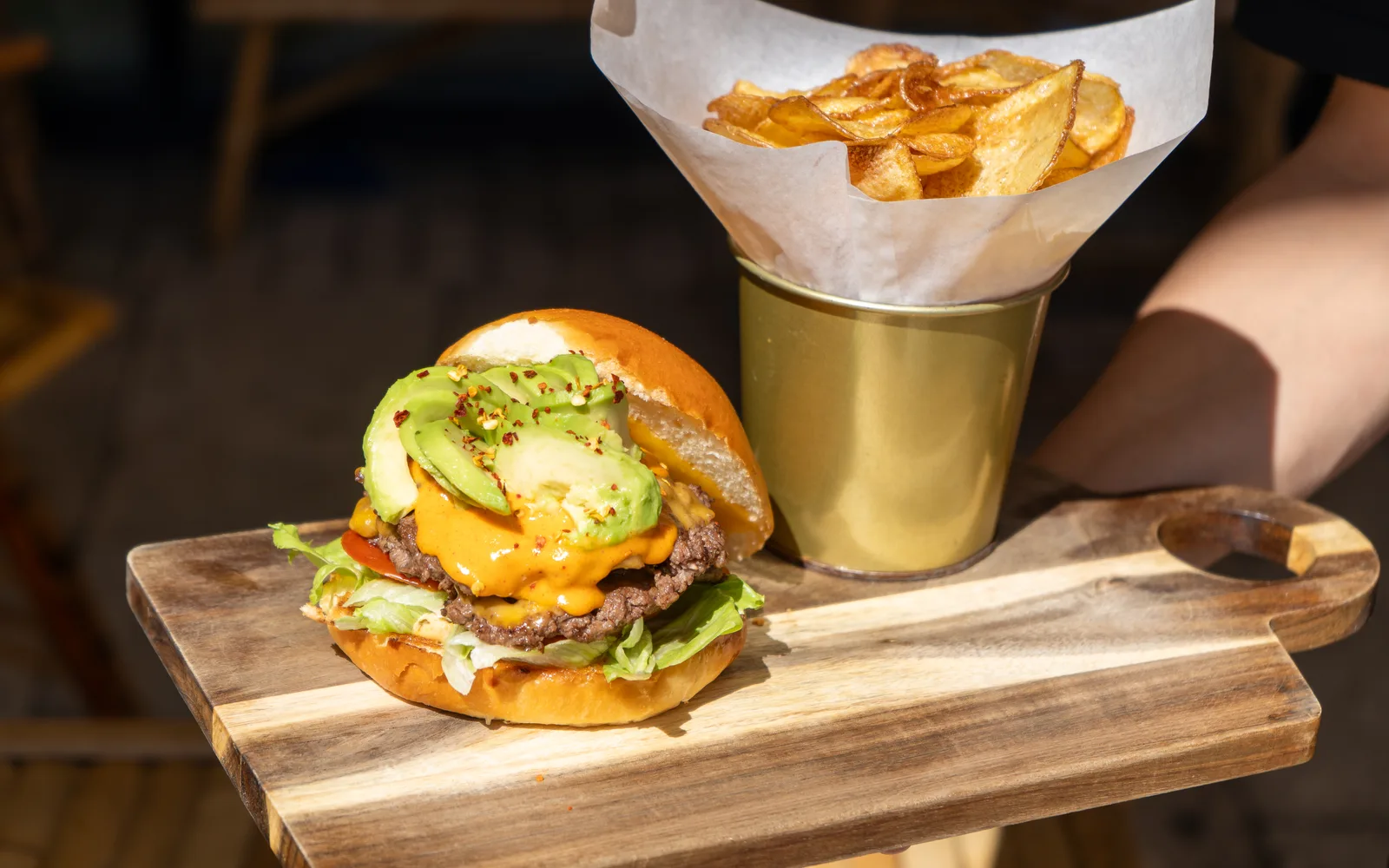
Our Avo Smashed Big Cheeseburger is two smashed beef patties, an avocado flower, cheddar, tomato and crunchy lettuce in a homemade pretzel bun, dressed with pepperoncini sauce, mango-mustard alioli and chili flakes and served with homemade potato chips, for 5,100 Ft at both Cookie Beacon brunch spots in Budapest.
It is the only plate on our menu for brunch in Budapest with two patties, and the only one the card names a burger; the Breakfast Crunch can be made into one for 900 Ft extra. Both spots serve it all day, and neither takes bookings.
Why is a smashed cheeseburger on a brunch menu?
Here is the reason, from the people who put it on the card:
Who doesn’t like a smashed cheeseburger? We love it. A touch of gently spicy peperoncini sauce and creamy fresh avocado turn a street staple into a brunch essential.
The owners’ starting point is the smashed cheeseburger itself, a street staple they love. Ours has what makes it one: two smashed beef patties under melted cheddar.
The brunch turn comes from two additions. The first is the pepperoncini sauce, the one they call gently spicy. Our card tags the burger spicy at both Budapest spots and puts chili flakes on top as well, so the heat comes from two places. If you want none, ask us to hold the spice when you order.
The second is the avocado, the Avo in the name. The card calls it an avocado flower (avokádóvirág). In the burgers we photographed, that means thin slices fanned in an arc over the stack, with the chili flakes scattered on them. Avocado turns up elsewhere on our Budapest brunch card too, smashed, on the Eggs Benedict on Cheddar-Scones and in the Grilled-Cheese Waffle-Sandwich. This is the only burger it tops.
Our kitchen makes every sauce by hand, the pepperoncini sauce and the mango-mustard alioli included.
What is on the Avo Smashed Cheeseburger?
Our Budapest menu lists ten things, here with their Hungarian names:
- Two smashed beef patties (2 lapított húspogácsa). Lapított means flattened. In our photos both are thin, with browned, craggy edges.
- Avocado flower (avokádóvirág). The Hungarian says the same, word for word.
- Homemade pretzel bun (házi sós perecbuci). One word, pretzelbun, on the English card; a salted pretzel bun on the Hungarian.
- Cheddar (cheddar). Melted over the patties.
- Tomato (paradicsom). One slice, under the patties.
- Crunchy lettuce (ropogós saláta). On the bottom half of the bun.
- Pepperoncini sauce (peperoncini szósz). The Hungarian side and the owners spell it with one p.
- Mango-mustard alioli (mangós-mustáros alioli). The card spells it alioli, and no other dish on it carries this sauce.
- Chili flakes (chili pehely).
- Homemade potato chips (házi burgonya chips). Thin, curled slices in a paper-lined cup beside the burger, included in the price.
The glossy orange sauce in our photos sits over the patties; the card lists two sauces without saying which one that is. Neither Budapest card prints an add-on for it.
What makes it a smashed burger?
A smash burger starts as a ball of ground beef. The cook sets it on a very hot griddle and presses it flat, so more of the meat touches the heat. That contact browns the surface into a savoury crust (the Maillard reaction) and crisps the thin edges.
Our card says two smashed beef patties and gives no patty weight or cooking time.
How do you eat it?
In the burgers we photographed, the bun’s lid leans against the stack and the avocado sits on top, open to the air. Fold the lid over, press down a little and pick it up in both hands. Two patties and two sauces make a tall stack, so expect some sauce on your fingers.
If you’d rather use a knife and fork, cut it in half first.
Eat the chips alongside, and use them to mop up any sauce that lands on the board.
Where do the cheeseburger and the smash burger come from?
Food historians still argue over who first put cheese on a hamburger. The name most often credited is Lionel Sternberger, a teenage cook at his father’s Rite Spot stand in Pasadena, California; the year usually given, 1924, is disputed. A 1928 menu from O’Dell’s in Los Angeles already listed a cheeseburger smothered in chili. Kaelin’s in Louisville, Kentucky, claims 1934, and in 1935 Louis Ballast of Denver’s Humpty Dumpty Drive-In received a trademark on the name.
The smash burger has rival origin stories of its own. Diners and roadside stands pressed patties flat on hot griddles for decades before the Smashburger chain, founded in 2007, helped make the name familiar.
Where does it sit among our dishes?
Four plates on our Budapest menu are its closest relatives:
- Breakfast Crunch Pretzelbun-Sandwich, 3,950 Ft. The English card gives it a homemade pretzelbun too, with sunny side up eggs, cheddar, tomato, crispy bacon, jalapeño and homemade potato chips. Its card offers to make it a smashed burger with a beef patty for 900 Ft extra. That gets you one patty with eggs and bacon; the Avo Smashed Big Cheeseburger has two patties and no egg.
- Philly Cheese Steak Protein-Bowl, 5,600 Ft. The only other plate built on beef: sirloin in cheese sauce, in a bowl. Its keto pretzel is a different bake from this burger’s bun, and the bowl carries a gluten-free tag the burger doesn’t.
- Cape Cod Shrimp Roll, 5,100 Ft. The same price, the same two tags (protein-packed and spicy) and the same homemade potato chips. Where the burger has a pretzel bun, beef and a mango-mustard alioli, the roll has toasted brioche, butter shrimp and a lemon aioli.
- Grilled-Cheese Waffle-Sandwich, 4,600 Ft. Cheddar and smashed avocado between waffles, with chips. If our team has to pick one signature, it is this one, the dish Cookie Beacon started its brunch with.
What should you know before ordering it in Budapest?
It sits in Hearty Brunch, the first section of our Budapest menu. The name stays in English on both halves of the card, so you won’t find it listed as sajtburger, the Hungarian word for a cheeseburger.
In Britain the side would be called crisps: thin, crunchy potato slices, burgonya chips on the Hungarian side.
The price is the same at Basilica on Hercegprímás utca, near St. Stephen’s Basilica, and at Ferenciek tere, at the Váci utca end of the square. Both open 08:00 to 17:00 on weekdays and 09:00 to 17:00 at weekends, and both are walk-in only. The walk between them takes about fifteen minutes.