On this walk, Kralja Petra street in Belgrade’s Old Town is the sight itself. The loop begins and finishes at Cookie Beacon Kralja Petra, our brunch spot on the street. It goes first to the ”?” tavern at No. 6, then back through the free National Bank exhibition at No. 12, the Kinoteka and the Jewish Historical Museum at No. 71a. The last stop is a church on Cara Dušana, and then you head back. Measured as straight lines, the nine legs come to about 2.6 km. The real streets add a little, and the Google Maps route gives the walking time. One thing to plan for: this is a weekday walk. The bank exhibition is closed at weekends, and Princess Ljubica’s Residence is closed on Mondays, so go Tuesday to Friday.
The device is simple. House by house means one building at a time. Here the house numbers are the chapters. Kralja Petra means “King Peter’s (street)”. It runs about 1 km on OpenStreetMap, from the cathedral down to Cara Dušana. Count the numbers yourself as you go: by the bottom of the street they reach the 90s.
Kralja Petra street, Belgrade: route at a glance
| # | Stop | House number | Straight-line from previous stop | Look for |
|---|---|---|---|---|
| 0 | Start | Kralja Petra 20a | — | — |
| 1 | Robni magazin, the old department store | Kralja Petra 16 | 75 m | The glass wall between two white marble pylons |
| 2 | Kafana ”?” | Kralja Petra 6 | 194 m | The ”?” above the door |
| 3 | Princess Ljubica’s Residence | Kneza Sime Markovića 8 | 68 m | The row of chimneys |
| 4 | King Peter I school | Kralja Petra 7 | 151 m | The arched windows above the entrance |
| 5 | National Bank of Serbia Visitor Centre | Kralja Petra 12 | 98 m | The old tellers’ hall |
| 6 | Kinoteka and the Karl Malden statue | Uzun Mirkova 1 | 209 m | A man in a hat, gripping a pole |
| 7 | Jewish Historical Museum | Kralja Petra 71a | 242 m | The inscription near the top of the façade |
| 8 | Church of St Alexander Nevsky | Cara Dušana 63 | 719 m | The bell tower and the dome |
| — | Back to the start | Kralja Petra 20a | 893 m | — |
Distances are straight lines between OpenStreetMap points, about 2,650 m in total, so the walk itself is longer. For minutes, use the Google Maps link above.
Base camp
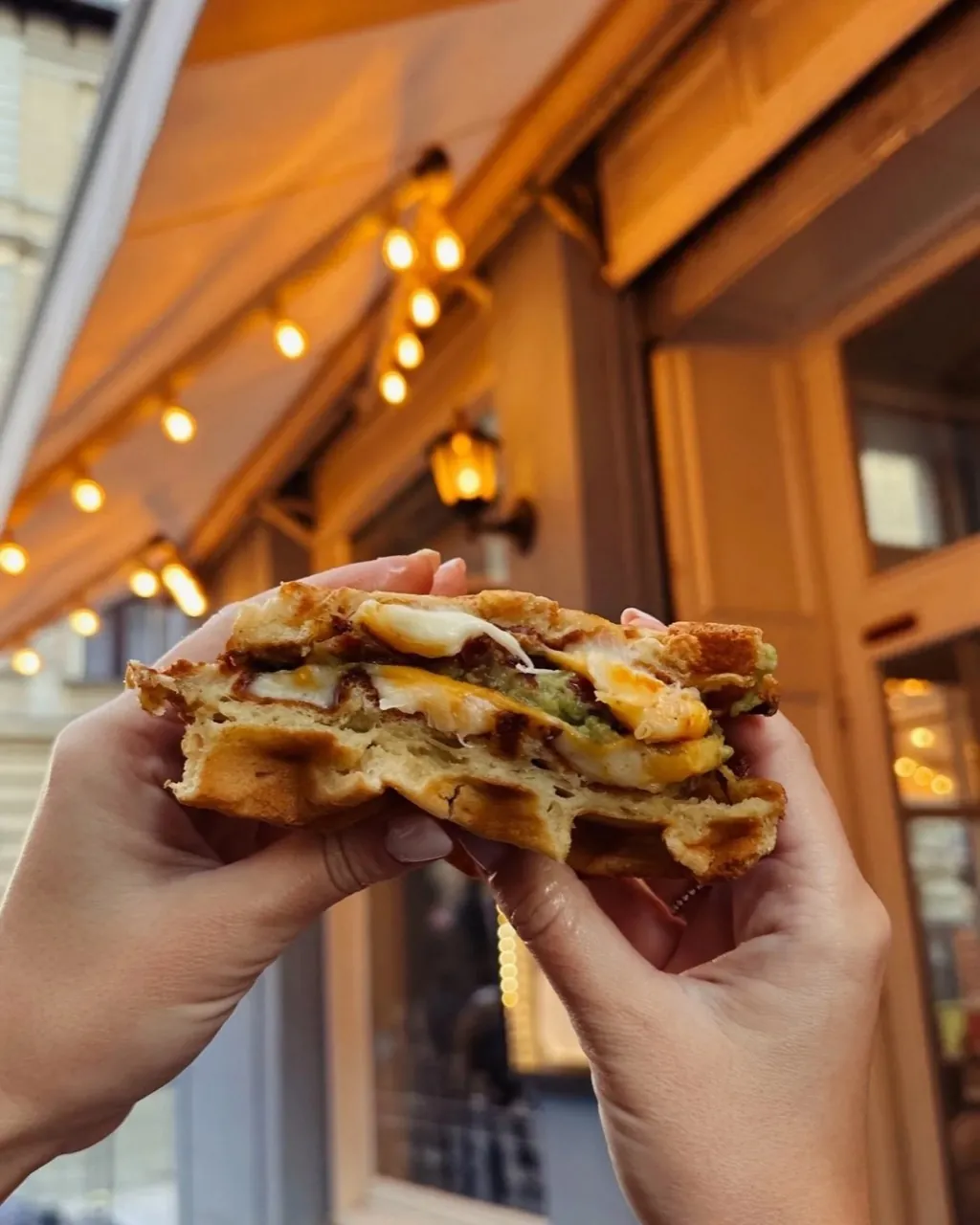
A base camp is the place you set off from and come back to. Ours opens at 09:00, and the bank exhibition opens at 10:00, so there is time to eat first. Order something filling enough for the whole walk: the Avocado Cheddar-Scones, or the Shakshuka di Bufala. Add a Flat White, roasted in Barcelona. The full list is on the Kralja Petra menu.
1. No. 16: Robni magazin, Belgrade’s first modern department store
Turn towards the cathedral end of the street. Within a few doors you reach No. 16. Engineer Viktor Azriel built it in 1907 for the banker Benćion Buli, as a department store. Serbian Wikipedia calls it the first modern one in Belgrade. The style is Art Nouveau, and the city listed it as a cultural monument in 1966 (sr.wikipedia).
Look for: the glass wall in an iron frame between two white marble pylons, under an arched top.
2. No. 6: Kafana ”?”, the question-mark tavern
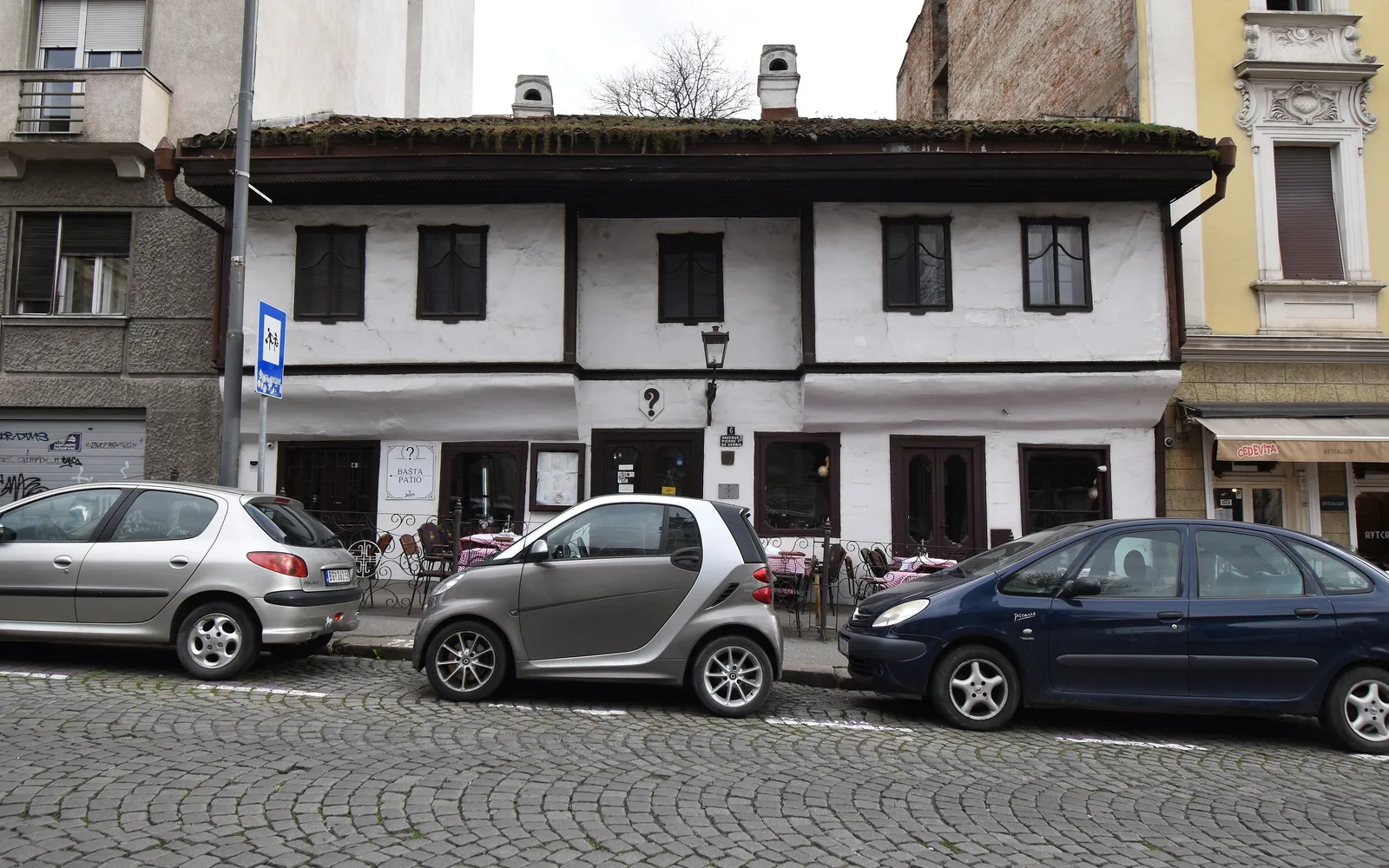
A kafana is a traditional Serbian tavern. This one sits in a low white house from 1823, built on the orders of Prince Miloš Obrenović. The prince later gave it to his personal doctor, who opened a tavern in it. In 1892 a new owner wanted to call it “At the Cathedral”, after the church across the street. The story goes that the Serbian Orthodox Church objected. So he put a question mark on the door until he could think of a better name. He never needed one (Wikipedia).
Look for: the small ”?” sign above the main door, and the house number plate beside it.
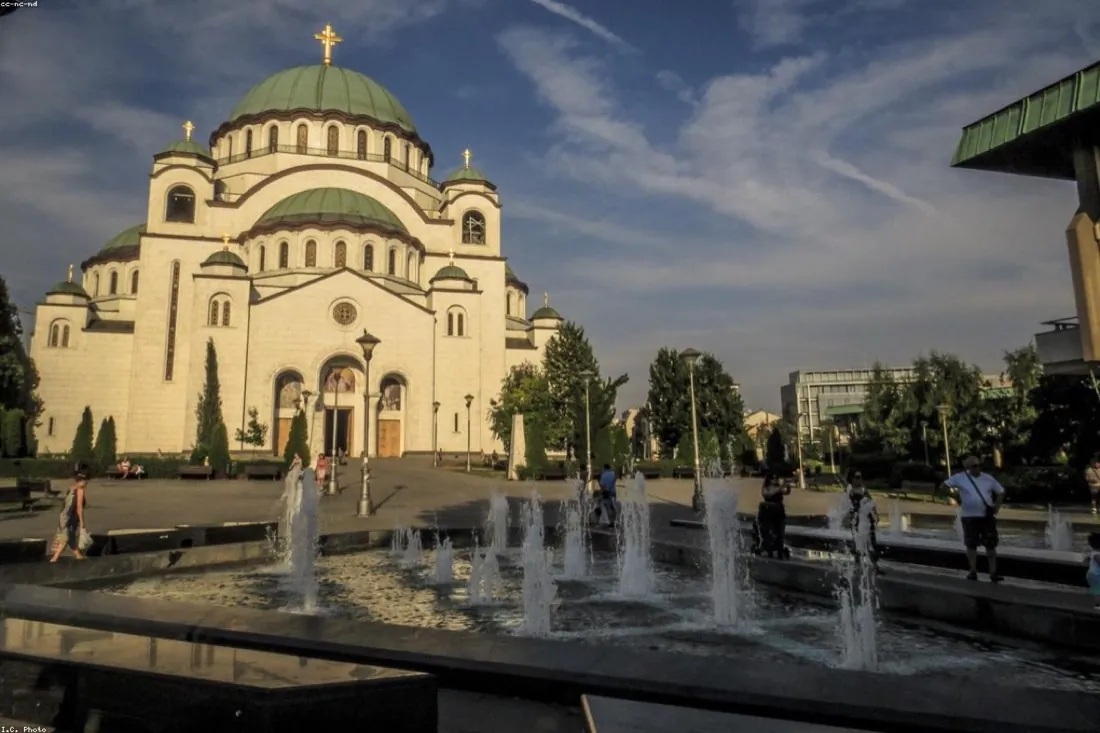
Across the street stands the Cathedral of St Michael the Archangel (Saborna crkva), 54 m away in a straight line. It is an active Orthodox church. If you go in, dress modestly and keep your voice low during services.
3. Princess Ljubica’s Residence
Step one block off the street to Kneza Sime Markovića 8. Prince Miloš had this house built in 1830 for his wife, Princess Ljubica. Hadži Nikola Živković drew the plans. Until 1839 it was a family home and also held the state treasury, the money of the young Serbian state. Today it belongs to the Belgrade City Museum. Inside are rooms furnished as 19th-century Belgrade homes, and the museum also opens the gates of the princess’s garden (Belgrade City Museum).

Photo: Никола Цветковић, resized, CC BY-SA 3.0, via Wikimedia Commons
Look for: the row of chimneys on the roof. Count them yourself.
4. No. 7: the King Peter I school
Back on Kralja Petra, No. 7 is a working primary school. Jelisaveta Načić designed the building in 1905–1907. English Wikipedia calls her the first Serbian female architect; she was about 27 at the time. The school traces its roots to 1718, and Belgrade lists the building as No. 1 on its register of cultural monuments. It is also credited with Belgrade’s first basketball match, in 1923 (Wikipedia).
Look for: the tall arched windows of the entrance bay. It is a school, so look from the pavement. Remember the architect’s name. She comes back at the end.
5. No. 12: the National Bank of Serbia Visitor Centre
The National Bank opened here in 1890, in a Neo-Renaissance building by Konstantin Jovanović. Inside, the former tellers’ hall now holds a standing exhibition, “Money in the Territory of Serbia – from its first appearance until today”. The National Bank says entrance, guided tours and interactive content are free. It is open on working days from 10:00 to 16:00. Individual visitors just walk in and look round on their own; guided tours are for groups, which book ahead (NBS Visitor Centre, checked on 21 October 2026).

Photo: Nemezis, resized, CC BY-SA 3.0, via Wikimedia Commons
Look for: the old tellers’ hall itself. Look up at the arches and the ceiling. Then find the oldest coin on display, and the newest note.
You have now seen two money houses in one morning. Princess Ljubica’s Residence held the state treasury in the 1830s. This building held the national bank from 1890.
6. The Kinoteka (Yugoslav Film Archive museum) and the Karl Malden statue
Walk back past our door and turn onto Uzun Mirkova, which means “Uzun-Mirko’s street”. In 1872 it became the first Belgrade street named after a hero of the First Serbian Uprising (sr.wikipedia). Uzun-Mirko was a commander in the Serbian uprisings. “Uzun” is Turkish for “tall”, a nickname he got for his height (Wikipedia). At No. 1 stands the Yugoslav Film Archive, the Kinoteka. The Tourist Organisation of Belgrade describes the building as a former residence of Prince Aleksandar Karađorđević and a former city hall (TOB).
Outside is a statue of Karl Malden, who won an Oscar for the 1951 film A Streetcar Named Desire (Wikipedia). He was born Mladen Sekulović. The sculptor Zdravko Joksimović made the statue, and it was unveiled in front of the Kinoteka in 2018 (N1).

Photo: Petar Milošević, cropped and resized, CC BY-SA 4.0, via Wikimedia Commons
Look for: Malden’s hat, the pole in his hand and the plaque his other hand rests on. A 2021 report on the archive’s museum lists Charlie Chaplin’s walking cane among its exhibits (nova.rs). Ask at the door whether it is on show today. The official site did not list museum hours on 21 October 2026, so phone first (number in the practical box).
Side quest: the Sekulić Icon Collection (Fridays)
A side quest is an optional extra. A few doors along, at Uzun Mirkova 5, is the Sekulić Icon Collection: 48 m in a straight line from the Kinoteka. The architect Milan Sekulić and his wife Pava gave their icons to the city in 1970. The collection is shown in their former home on the first floor, in a building Sekulić designed himself. Entry is free. On weekdays it opens only on Friday, 10:00–18:00 (Belgrade City Museum, checked on 21 October 2026). There are steps at the entrance and a lift inside.
7. No. 71a: the Jewish Historical Museum
Go back to Kralja Petra and follow it downhill. The numbers climb fast. At No. 71a, on the first floor, is the Jewish Historical Museum, founded in 1948. It holds documents, photographs and objects from Jewish life in Serbia and Yugoslavia, and collections on the Holocaust. The building was completed in 1928 for Belgrade’s Sephardic community (Wikipedia).
Look for: the inscription near the top of the façade, which names the building as the home of the community’s religious and school society.
No official page lists current opening hours, so call the museum before you go: +381 11 262 26 34 (Tourist Organisation of Belgrade). The website listed for it no longer belongs to the museum (checked 21 October 2026).
8. The Church of St Alexander Nevsky
Follow Kralja Petra to its end at Cara Dušana, then follow Cara Dušana south-east to No. 63. This is an active Orthodox church. A first church stood here from 1877. The foundations of the present one were consecrated in 1912, and war delayed the works until about 1929 (Wikipedia). The architect chosen for it was Jelisaveta Načić, who designed the school at No. 7. So one architect stands at both ends of the walk.

Photo: Andrija12345678, resized, CC BY-SA 4.0, via Wikimedia Commons
Look for: the bell tower and the dome above Cara Dušana. If you go inside, dress modestly.
If it’s raining, a Monday or a weekend
- Raining: four stops have a door you can go through: the bank exhibition, Princess Ljubica’s Residence, the Jewish Historical Museum and, on Fridays, the icon collection. Do those, and save the façades for a dry day.
- Monday: the bank exhibition is open, but Princess Ljubica’s Residence is closed. See it from outside and keep going.
- Weekend: the bank exhibition is closed. Princess Ljubica’s Residence and the Sekulić collection are open on Saturday and Sunday (hours below). The street itself is always open.
- More time: the Bajrakli Mosque is 56 m from No. 71a in a straight line. It belongs to our Dorćol walk down to the Danube, which starts at the same door.
Return to base
From the church it is 893 m back in a straight line, uphill along Cara Dušana and Kralja Petra. Most of the walk’s climb is in this last leg. Back at our Kralja Petra door, finish the last chapter with a Cinnamon-Roll Cookie or a Lotus & Dulce de Leche.
Practical box
Every hours fact below was checked on 21 October 2026 on the official page linked. Hours change, especially on public holidays, so check again on the day.
| What | Detail | Source |
|---|---|---|
| Best days | Tuesday to Friday. Friday adds the icon collection | the rows below |
| National Bank of Serbia Visitor Centre, Kralja Petra 12 | Working days 10:00–16:00. Free. No booking for individual visitors, who look round on their own; guided tours are for groups, which book ahead | centarzaposetioce.nbs.rs |
| Princess Ljubica’s Residence, Kneza Sime Markovića 8 | Tue, Wed, Thu and Sat 10:00–17:00; Fri 10:00–18:00; Sun 10:00–14:00 (10:00–13:00 on days with the theatre show); Mon closed. Ticket 300 RSD; free on the last Saturday of the month | mgb.org.rs (the site showed an expired security certificate) |
| Sekulić Icon Collection, Uzun Mirkova 5 (first floor) | Fri 10:00–18:00; Sat 10:00–17:00; Sun 10:00–14:00. Free. Steps at the entrance, lift inside, no ramp at present | mgb.org.rs |
| Kinoteka, Uzun Mirkova 1 | Museum hours not listed on the official site. Phone +381 11 262 25 55. The archive’s other hall, in Kosovska street, has been closed for renovation since 14 February 2026 | kinoteka.org.rs, TOB |
| Jewish Historical Museum, Kralja Petra 71a (first floor) | No current opening hours published (checked 21 October 2026). Call +381 11 262 26 34 first | TOB |
| Churches | Saborna crkva and St Alexander Nevsky are active churches. Modest dress; services come first | — |
| Surfaces and slope | Expect cobbles: OpenStreetMap tags the lower part of Kralja Petra as stone setts, and the stretch by Nos. 10–20 is pedestrian. The top of the street is nearly level with the start. The climb comes at the end: the church on Cara Dušana sits about 34 m below the start | OpenStreetMap; EU-DEM 25 m elevation model |
| Route | About 2,650 m of straight-line legs. Open the route in Google Maps for walking time. In a phone browser without the Maps app, Google may show only some of the stops | Google Maps |
More walks and plans
If this is your first visit to the city, our first day in Belgrade plan covers the basics before you set off. For a downhill route from the same door, try the Dorćol walk. In Budapest, the same idea works behind Ferenciek tere: seven doors to Budapest’s courtyards. And for the base-camp order, the Kralja Petra menu has every dish.
Photo credits: hero image by Fred Cherrygarden, cropped and resized, CC BY-SA 4.0, via Wikimedia Commons.