A traditional Serbian breakfast is early and hearty. At home it is bread with butter, jam, yogurt, sour cream or cheese, alongside bacon, sausage, salami, eggs or kajmak, the Balkan clotted cream. Out of the house it comes from the pekara (bakery): a piece of burek, the phyllo pie filled with cheese or meat, with a drinking yogurt, or pogačice and kifle. Proja, a cornbread served with ajvar and kajmak, and gibanica, a cheese-and-egg phyllo pie, fill out the table, and the day usually starts with a domestic coffee or an espresso. Lunch, eaten in the early afternoon, is the main meal. Our brunch spot in Belgrade does something different, a plated brunch from 09:00 every day, and the last part of this guide sets the two side by side. Every Serbian dish below names the public source we took it from, and the links are listed at the end.
The traditional Serbian breakfast table
Wikipedia’s entry on Serbian cuisine sums up the rhythm of the day: “breakfast is strong, consisting of savory pastry, while lunch is the most important, eaten in early afternoon, and dinner is light.” It calls breakfast “an early but hearty meal, rich in calories and carbohydrates”.
The home version is built on bread. “Bread is frequently served with butter, jam, yogurt, sour cream, or cheese, accompanied by bacon, sausage, salami, eggs, or kajmak,” in the same entry’s words. Dairy carries a lot of the meal: buttermilk, kiselo mleko (soured milk), kajmak, yogurt, strained yogurt and pavlaka (sour cream) are, again per Wikipedia, “common breakfast foods, consumed daily”.
One more name turns up beside the bread: ajvar. Explore Serbia calls it “a special type of salad”, made of red pepper and shared across the Balkans rather than Serbian alone, and says it is used “most often as a bread spread”. At breakfast it goes with proja, as the cornbread section below shows.
Burek and yogurt: the bakery breakfast
Out of the house, a Serbian breakfast means the pekara. Wikipedia’s Serbian cuisine entry says Serbians “often stop by a bakery in the morning for fresh pastries”, and lists pogačice, kifle (which may be sweet or sprinkled with salt crystals), pletenice (plaited bread), štapići (breadsticks), đevrek (sesame bread) and fried dough such as mekike and uštipci.
The headline item is burek. According to Wikipedia’s burek entry, in Serbia it is baked with no filling (prazan, “empty”), with stewed minced meat and onions, or with cheese, and “it is often eaten along with a plain yoghurt drink”. The recipe for round burek was developed in Niš, where a baker from Istanbul introduced it in 1498, and Niš still holds an annual burek festival, the Buregdžijada. The World Travel Guide says burek “is widely eaten for breakfast or as a quick snack”.
Belgrade has a classic order. The Nutshell Times, a Belgrade food blog, described it in 2014 as “250g of burek (with cheese) in the morning, accompanied by jogurt (fluid yoghurt)”, and its pick that year was the Trpković bakery. The yogurt here is a drink, not a dessert: Wikipedia notes that yogurt and kefir “frequently accompany savory pastries”.
Burek is not the only phyllo pie at breakfast. Wikipedia’s Serbian cuisine entry says Serbian pies “are eaten either for breakfast, dinner, or as a snack”, and lists gibanica beside burek. Gibanica is “usually made with cottage cheese and eggs”, and its Wikipedia entry says that in Serbia it is eaten “as breakfast, dinner, appetizer and snack”, and at Christmas, Easter and the family slava.
Kajmak, proja and the slower breakfasts
Kajmak turns up on almost every Serbian breakfast list above. Wikipedia’s kajmak entry describes it as “a creamy dairy food similar to clotted cream”, made by boiling raw milk slowly, simmering it for two hours and skimming off the cream, which is left to chill and ferment mildly. It says kajmak is usually enjoyed “for Saturday morning breakfast (as Saturdays are market days when the best kajmak can be bought)”, and that the simplest way to eat it is lepinja s kajmakom, a round flatbread filled with kajmak, “consumed for breakfast or as fast food”.
Proja is cornbread, which Wikipedia calls “a national dish of Serbia”, made from corn flour, baking powder, sunflower oil, sparkling water and salt. “It is usually eaten for breakfast with ajvar and kajmak.” Explore Serbia adds that cheese, kajmak, spinach or Swiss chard can go into the batter.
Wikipedia’s Serbian cuisine entry also lists kačamak (maize porridge), cicvara and popara, a dish of stale bread, among the common breakfast dishes.
Coffee first: domaća kafa
“Before breakfast most people usually have a cup of traditional coffee (domaća kafa) or espresso,” says Wikipedia, “and with the breakfast itself either tea, milk, milk coffee, or chocolate milk.” Domaća kafa (“domestic coffee”) is Turkish-style coffee: Wikipedia’s Turkish coffee entry says that in Serbia it is called “Turkish coffee”, “domestic coffee” or simply “coffee”, and also srpska kafa, “Serbian coffee”.
The same 2014 Nutshell Times guide had a Belgrade place for it: a Turkish coffee in the morning at ”?”, “looking at the spire of Saborna crkva from the street garden”. The ”?” kafana is at Kralja Petra 6, in a building from 1823, and Wikipedia calls it the oldest traditional tavern still operating in Belgrade. It is on the same street as our brunch spot.
Serbian breakfast glossary
| Serbian | What it is | Source |
|---|---|---|
| doručak | Breakfast | — |
| pekara | Bakery | — |
| burek | Phyllo pie, plain or with meat or cheese | Wikipedia, World Travel Guide |
| jogurt | Drinking yogurt, the usual partner to burek | The Nutshell Times, Wikipedia |
| kiselo mleko | Soured milk | Wikipedia |
| pavlaka | Sour cream | Wikipedia |
| kajmak | Clotted-cream-like dairy food skimmed from simmered milk | Wikipedia |
| lepinja s kajmakom | Round flatbread filled with kajmak | Wikipedia |
| proja | Cornbread, eaten with ajvar and kajmak | Wikipedia, Explore Serbia |
| gibanica | Phyllo pie with cheese and eggs | Wikipedia |
| pogačice | Small layered pastries | Wikipedia, The Nutshell Times |
| kifle | Bread rolls, sweet or with salt crystals | Wikipedia |
| uštipci | Fried dough | Wikipedia |
| ajvar | Red pepper relish, eaten on bread and with proja | Explore Serbia, Wikipedia |
| domaća kafa | Domestic (Turkish-style) coffee, also called srpska kafa | Wikipedia |
Where Cookie Beacon fits
Nothing on the Cookie Beacon card is a traditional Serbian breakfast dish, and we would rather say so than dress a brunch plate up as one. Cookie Beacon is a family-run brunch brand, founded in 2021, and its one brunch spot in Serbia is Cookie Beacon Brunch Kralja Petra at Kralja Petra 20a in Stari Grad, near Republic Square and Kalemegdan. It is open every day 09:00–18:00, walk-ins only. One difference first: a Serbian breakfast starts early and we open at 09:00, so for a 07:00 breakfast the pekara is your answer.
Here is how our Belgrade menu lines up against the Serbian table:
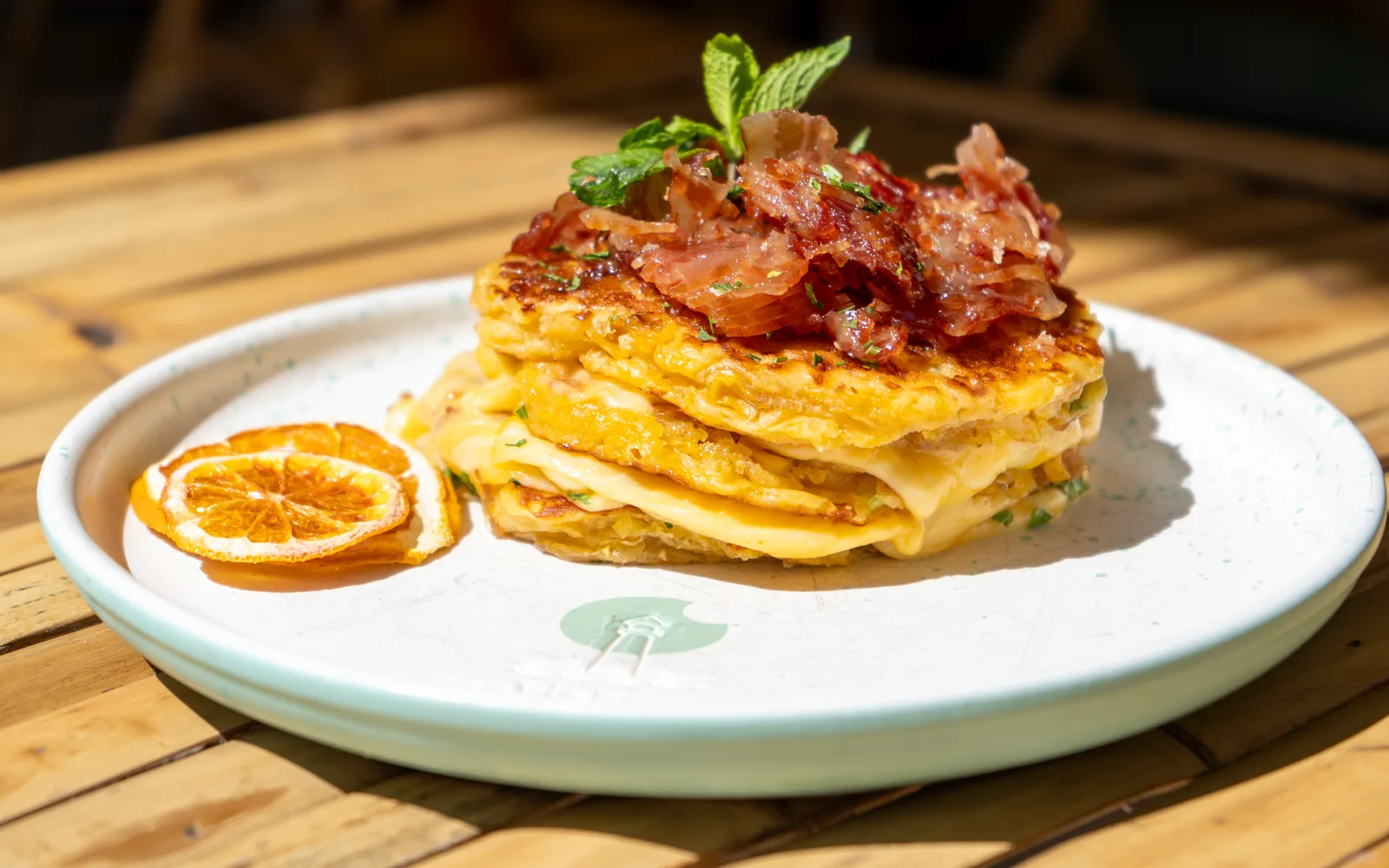
- Eggs and bacon. The Serbian table puts eggs beside bacon and sausage. Our Croque Madame Pancake Stack (1,190 RSD) puts sunny-side-up eggs, cheddar béchamel and crispy bacon on buttermilk pancakes. Eggs Benedict on Cheddar-Scones (990 RSD) are poached eggs, hollandaise, feta crumble and smashed avocado on freshly baked cheddar scones. The Breakfast Crunch Pretzelbun-Sandwich (1,350 RSD) layers a sunny-side-up egg, cheddar, crispy bacon and jalapeño in a homemade pretzelbun.
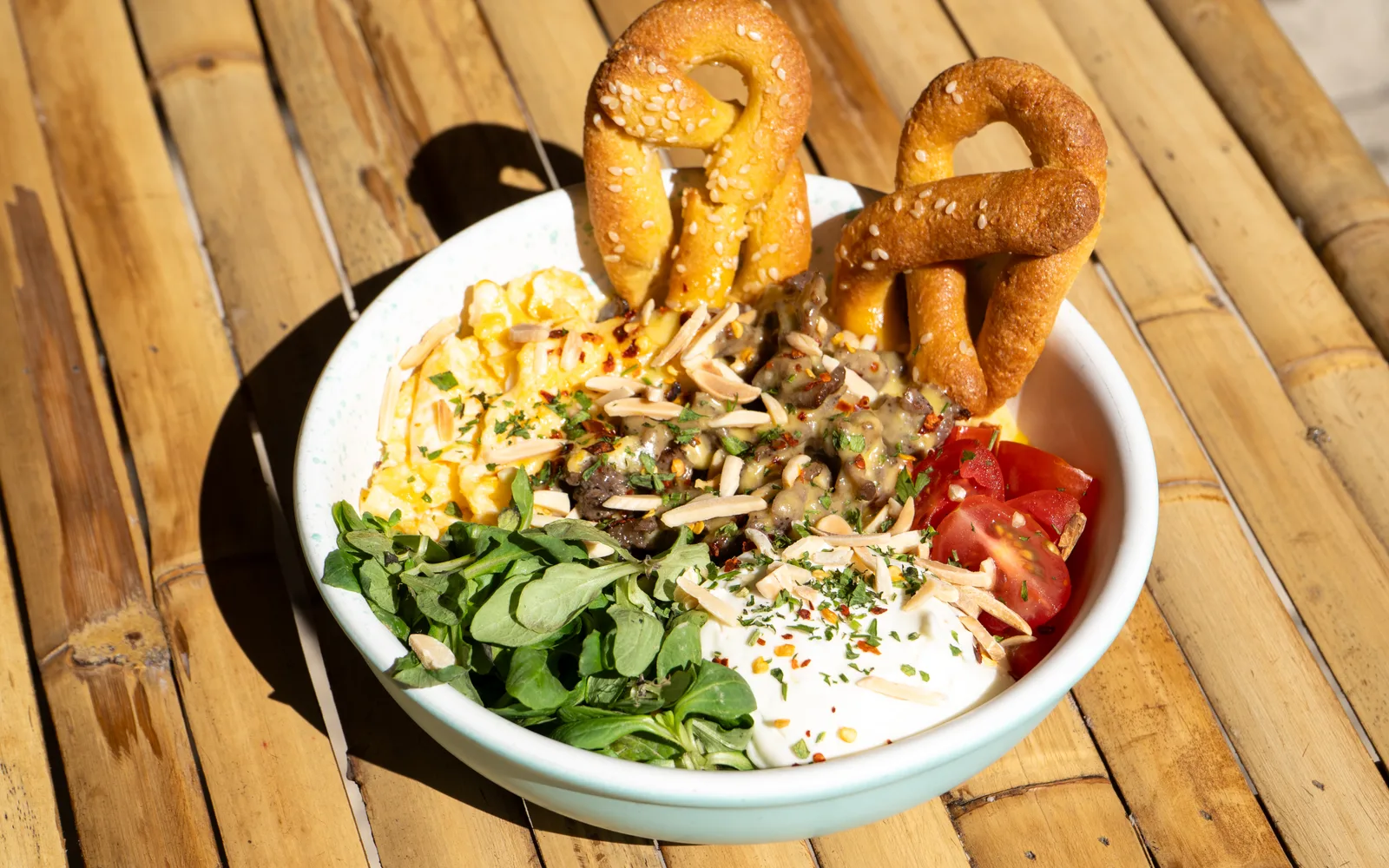
- Eggs and sour cream. Eggs and pavlaka both sit on the Serbian table. The nearest plate on our card is the Philly Cheese Steak Protein-Bowl (1,550 RSD): scrambled eggs, sirloin in cheese sauce, homemade sour cream and a keto pretzel, marked gluten-free. It is a different dish.
- Yogurt. Burek’s partner is a drinking yogurt. Ours comes in a bowl: the Yogurt & Honey Whipped Granola Bowl (990 RSD) is Greek yogurt with honey, honey-toasted granola and blueberries, and it is marked gluten-free.
- Peppers, tomato and egg. If proja with ajvar is your reference point, Shakshuka di Bufala (1,450 RSD) is the plate nearest in colour: a sunny-side-up egg in a spiced tomato and pepper sauce with feta crumble and homemade seed crackers. The card offers a vegan version with a tofu-crumble swap.
- Something from the oven. Burek, pogačice and kifle are not on our menu. What we bake in-house is cheddar scones, which go under the Avocado Cheddar-Scones (990 RSD) and the Eggs Benedict, the pretzel buns of the Breakfast Crunch sandwich, a brioche loaf for the Crème Brûlée French Toast (1,190 RSD), seed crackers for the shakshuka, and handmade chunky cookies, 550 RSD each, from Classic Choco Chip to Nutella & Maldon Salt.
- Coffee. There is no domaća kafa on our card. Our specialty coffee is light-roasted in Barcelona: an espresso is 275 RSD, and the nearest thing to a milk coffee is a cappuccino (385 RSD), a flat white (395 RSD) or a latte (395 RSD). If chocolate milk is your breakfast drink, the S’mores Hot Chocolate is 450 RSD.
For the Serbian version, walk into a pekara and order a burek with a jogurt; for a sit-down plate of eggs and a coffee from 09:00, that is the part we do.
| Detail | Cookie Beacon Brunch Kralja Petra |
|---|---|
| Address | Kralja Petra 20a, 11000 Belgrade |
| Neighbourhood | Stari Grad (Old Town), near Republic Square and Kalemegdan |
| Hours | Every day 09:00–18:00 |
| Bookings | Walk-ins only |
| Dogs | Well-behaved dogs welcome |
| Espresso | 275 RSD |
| Egg plates | Eggs Benedict on Cheddar-Scones 990 RSD, Croque Madame Pancake Stack 1,190 RSD |
| Yogurt | Yogurt & Honey Whipped Granola Bowl 990 RSD |
| Chunky cookies | 550 RSD each |
| Full menu | Kralja Petra menu |
Planning your first morning in Belgrade
Our first day in Belgrade food guide takes you from brunch in Stari Grad down Knez Mihailova to Kalemegdan, a bakery lunch and a kafana dinner in Skadarlija. It is also in Serbian. For the whole Kralja Petra card, plates and prices, read our guide to brunch in Belgrade. And if Budapest is next on the trip, here is what Hungarians eat for breakfast; for Bucharest, what Romanians eat for breakfast.
Sources, checked 14 October 2026: Wikipedia, Serbian cuisine; Wikipedia, Burek; Wikipedia, Kajmak; Wikipedia, Proja; Wikipedia, Gibanica; Wikipedia, Turkish coffee; Wikipedia, ”?” (bistro); Explore Serbia, Serbian food; World Travel Guide, Serbia food and drink; The Nutshell Times, The Nutshell Guide to Belgrade (2014): Top foods. Cookie Beacon dishes, prices and hours come from our own Belgrade menu and opening times.